Tag: influence (page 4 of 4)

The first Influence Scorecard meeting

Thanks to all you lovely social Web analytics people who've emailed me about your excitement and concerns regarding the Influence Scorecard. I'm also delighted that Katie Delahaye Paine and Charlene Li have expressed their desire to be part of this (although to be fair I haven't checked back with Charlene since February... are you around next week Charlene?)

I do appreciate your enthusiasm, but of course I wanted to post here about your concerns too. Once we have these concerns out of the way, it would be great to get these conversations into the public domain so I don't have to write long blog posts keeping everyone up to date!

Given that I've been asked, let me start by saying why I love this space. Quite simply, it combines several passions of mine: organisational efficiency and effectiveness; the Internet and information technology; social media, democracy, consumer empowerment and community invigoration; mathematics and data visualisation.

But that's me. What about the analytics industry? Why should competitors get in a room and tease this out collaboratively? That's the concern some of you have raised, and there are two responses to this question. Read more

An outline of the Influence Scorecard

It has been a busy year for me with my departure from Racepoint Group following my so-called "transition period" and my setting up a new consultancy. So apologies for the delay in getting back on the topic of the Influence Scorecard.

It hasn't been far from my mind, particularly following the oodles of positive feedback in January and February, and believe you me, I'm intent on taking up your expressions of interest to meet before the year is out to take this forward. I want to collaborate with you. I want to find the most forward thinking social Web analytics vendors and forward thinking CMOs to put this into action, and commence the empirical fine tuning of the approach.

Most encouragingly, I have had fourteen companies in the social Web analytics space express their intent to get involved.

So I'm leaping back into it with a SlideShare presentation. It's concise. It's an outline, and focuses on the what rather than the how. Read more

Visualising content to improve your understanding of the conversation

Data visualisation is a hobby of mine and a frequent topic of my posts. Frequent readers will know that I believe data visualisation to be invaluable to PR professionals in their craft, in their seeking to understand and exert influence.

IBM's awesome Many Eyes service has recently introduced a new way of visualising swathes of text ("unstructured data" in the words of the experts). An analysis they've called "Phrase Net". The easiest way to demonstrate what that means is simply to post up an example.

So I took the text from the last three months of featured posts on MarCom Professional and pasted it into Many Eyes and selected the Phrase Net visualisation, and hey presto...

marcomprofessional phrase net

Read more

Enhancing Organisational Performance Management with the Influence Scorecard

Influence%20Scorecard

Last week I posted about hosting a meeting on the Influence Scorecard. The post was testing the water to determine the level of interest such an event might generate, and I was answered by dozens of emails, direct twitters, comments and even some direct editing of the post itself, as I'd hoped! (MarCom Professional allows an author to permit others to edit a post, wiki-style.)

I even received tentative enquiries about sponsorship, so it looks like we are on to something here...

Moreover, the interest was split almost 50:50 between Europe and North America, and it was spread fairly evenly amongst each of the required participant groups.

What is clear from all the queries and interest is that we now need to put some meat on the bones.  Here are a few top line thoughts on 'influence', 'scorecard' and what we hope to achieve.  Your thoughts are welcome.

Influence

Organisations want to influence the opinion and behaviour of their stakeholders. They do this via the various marketing and communications disciplines and approaches - PR, advertising, branding, community building, conversational marketing, direct marketing, events, product placement, public affairs, sponsorship etc..

Of course, stakeholders also influence each other and some will want to influence an organisation - how ready an organisation is for this dialogue is another matter.

Scorecard

The 'scorecard' is inspired by the Balanced Scorecard, one of the most widely adopted organisational performance management methodologies (generally known as "business performance management" or just plain BPM). According to the Balanced Scorecard Institute: Read more

Visualising your world of influence with Skyrails

protein%20visualisation%20on%20Skyrails

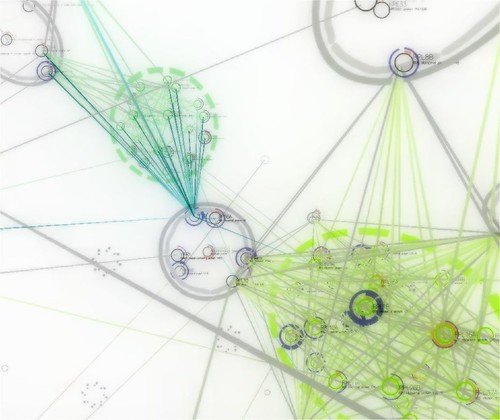
Marketing communications operates within an increasingly complex multi-stakeholder web of influences, and the way many of us can or will be able to devine how influence goes around and comes around, how reputations get built up and eroded, is to look at it pictorially.

My best attempt to date at explaining this in non-mathematical language is in my post "Can you see it? Making influence visible." Check it out.  More widely, my post "Influence... it's a numbers game", lists all my posts related to this topic. Read more

Influence Scorecard – defining influence measurement for organisational performance management

Influence%20Scorecard%202009

When I first decided to write The Social Web Analytics eBook 2008, I had no idea it would attract over 10,000 downloads in 100 days. And why does it continue to be downloaded 1,000 times a month? In hindsight, the reasons are plain:

  • Listening to and learning from all our stakeholders is a widely and keenly felt desire
  • Acquiring a grasp of the reputation our company and brands have notched up must constitute a key organisational performance metric for anyone
  • Understanding how our interaction and dialogue with our stakeholders contributes to the achievement of our marketing and communications objectives helps us quantify how well we are meeting those objectives. Read more