Tag: influence (page 3 of 4)

The Role of PR in a Digital Age

I'm in Kiev this evening preparing my presentation for tomorrow's European PR Congress 2011. I'm the first session of the day so I have the challenge of exciting the delegates, with getting some energy in the room. I was fascinated by the enthusiasm from the audience when I presented last month in San Francisco, so it'll be interesting to compare the two.

Now, I was briefed by event organiser Marina Starodubska (General Director, Partner, Mikhailov&Partners.Ukraine) that social media in Ukraine has not yet gained the momentum it has in Europe and the USA for example. She estimates that household broadband Internet penetration is just 26% [updated following the first comment below]. Interestingly, however, according to Total Telecom in July last year: "Ukraine as a whole had 55.60 million mobile subscriptions... putting penetration at 121.2%."

Whilst I haven't been able to find a breakdown of feature phones and smart phones, the waiting staff in the restaurant this evening indicated that such devices are booming. In the car to the hotel I also noticed that Nokia is investing in quite a big outdoor advertising campaign here for its feature and smart phones.

My stack for tomorrow is included here. The majority of the slides are taken from the longer stack from last month's Dreamforce, so if you took a look at that, you might not want to take the time here. But it's more the narrative I intend to tailor for this event. The emphasis tomorrow is simple – Public Relations, as defined by the Excellence Study, has a very bright future. Read more
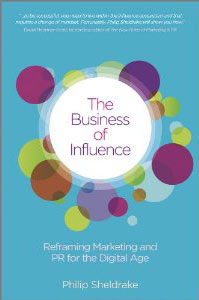
My book, The Business of Influence, is out today

Today's the day!

It's ready for delivery in the UK today, and pre-order in other parts of the world. For those of you tweeting about availability in the US, currently listed as mid-June by some bookstores, Wiley tells me it should actually be with you mid-May. Thank you for your interest and patience.

What's it about?

The Business of Influence: Reframing Marketing and PR for the Digital AgeThe Business of Influence is a rethink.

It's about improving the capabilities of organisations to design and attend to the way in which all aspects of its operations influence stakeholders, about making sure stakeholders influence it, systematically, and about how well competitors are attempting the same. It focuses on influence as the common denominator of marketing and public relations and related activities such as customer service, sales, product development and HR, and therefore the basis for redesigning these and interconnecting them.

The book introduces the Influence Scorecard, named in homage to the dominant framework for business performance management, the Balanced Scorecard. The Influence Scorecard then is a subset or view of the Balanced Scorecard containing all the influence-related key performance indicators (KPIs) stripped of functional silo, and it may extend beyond the Balanced Scorecard should a greater operational granularity of metrics be demanded by the influence strategy.

The Influence Scorecard is a new framework for the 21st-century designed to help organisations focus on what matters rather than continue to carry the baggage and inefficiencies that come part and parcel of the typical 20th-century marketing and PR structure and approach. It's a reframing in the context of 21st-century media and disintermediation, 21st-century technology, and 21st-century articulation of and appreciation for business strategy. Read more

What’s the ROI of social media?

I was delighted to have the opportunity to present my take on the ROI of social media to approximately 80 people yesterday evening at the Digital Publishing Forum. It seems this was a hot topic of interest; as well it should be.

I sought to put the topic into perspective with the following challenge. What's the ROI?...

  • Of the latest rebrand?
  • Of the office refurb?
  • Of the internal communications activity?
  • Of the training and development programme?
  • Of the upgrade to Windows 7?
  • Of the new standard issue smartphones?
  • Of the stakeholder engagement via social media?

If you'd like to see where we went from there, here's the presentation:

Thanks to Julia Lampam (@JuliaLampam) for the invitation to speak.

Influence in the age of the social web – keynote to EUPRERA

It's a beautiful sunny Spring day here at the EUPRERA Spring Symposium in Lisbon. It's my first time at this gathering of the European Public Relations Education and Research Association – the forum for innovative PR research and education – and I'm delighted to have been invited to deliver the keynote.

Thanks to Philip Young and David Phillips for the invitation. Here's the slidestack. I was a bit surprised to get a slide count of 77, but 16 of the slides present the infographic 'Content – An illustrated history', which is easy to breeze through :-)

Friday Roundup – Goodbye AVEs

Following establishment of the Barcelona principles in June this year and the annihilation of any idea that AVEs (advertising value equivalents) represent the value of public relations, AMEC (the Association for Measurement and Evaluation of Communication) has moved on to ask two questions:

  • What are the “validated metrics” to replace AVEs?
  • How do you get started in measuring social media, and what are the definitions of relevant metrics?

This work is being led by the US Agency Research Leaders Group chaired by Ketchum’s David Rockland, and formed a significant chunk of the conversation at last week's IPR 8th Annual Measurement Summit.

If you're looking for one slidestack that walks you through the principles and explores the progress made to date in answering the questions above, check out this presentation: "Validated Metrics - Social Media Measurement", delivered during the summit by Mike Daniels (Director, Report International and Chair, AMEC) and Tim Marklein (Executive Vice President, Measurement & Strategy, Weber Shandwick), and moderated by Peter Wengryn, CEO, VMS.

I think the work to date is most definitely going the right way; seeking to identify the desired outcomes of a public relations programme and working backwards so to speak to establish metrics that belie the programme's success accordingly. And I was particularly pleased with slide 25 on influence rating / ranking which corroborates my recent contribution to the Monitoring Social Media conference, "the fallacy of the influentials".

This jigsaw is coming together. We will have some operationally sound frameworks available next year, and I'm hoping my own book, "The Influence Professional", might make some useful contribution when it emerges from the publishing process in Spring. Whatever the timeline, you should have begun winding down any remaining reliance you have on AVEs by now. It's not a case of waiting to transition from mediocity to good; AVEs don't even make the cut as mediocre, they are specious, misleading and unprofessional. Period. Read more

The fallacy of the influentials

Monitoring Social Media Boston 2010

Life's complicated, so we better get used to it. That's my remote contribution to the Monitoring Social Media conference, Boston 2010. In other words, your marketing and PR campaign does not pivot around finding and persuading 10, 20 or 50 so-called influentials.

We should de-emphasise the application of social Web analytics (aka social media analytics, listening platforms, social monitoring) to finding the influentials. Rather, we should employ these amazing tools and services to actively listen, to learn from the conversation and to facilitate the workflow aspects of joining in the conversation.

Life is complicated. Influence is complex. And it appears that we're influenced more by our respective 150 nearest and dearest family and friends more often than the other 6 billion combined! I discuss the evidence for this assertion in my video here:

Read more

The most exciting development in PR since the Cluetrain

The Semantic Web, aka Web 3.0, is here. Now. And there is, as yet, little concerted recognition of or contribution to it by the influence profession... all the converging marketing and PR disciplines.

But is about to arrive in our lives, and in a big way. For example, what if I told you that when Best Buy embraced aspects of the Semantic Web its website saw a 30% increase in traffic.

Got your attention?!

Thanks to the following for their time and attention last night:

Influence – The bullshit, best practice and promise

Here is the presentation I just delivered to Monitoring Social Media Bootcamp.

It seems to have gone down well from the Tweetstream (some Tweets cut and paste below). Thanks so much to the panellists, particularly as you had approximately zero seconds to prepare!

UPDATE 2nd April 2010: I'm delighted that my presentation on slideshare.net has, according to emails I received from slideshare, been their most discussed document on Twitter and Facebook, globally! That means the presentation was promoted to their homepage too. How cool is that?

Read more

How the Influence Scorecard radically transforms marketing and PR

OK, so the title of this post grabbed your attention. Regular readers will know that we ran the first Influence Scorecard workshop in New York last week, and I took the action to diagrammatically represent the journey we've embarked on. And here it is. And you can track its progress, indeed join our team, at http://influencescorecard.wikispaces.com.

influence scorecard architecture draft

This is a first stab, and at a guess represents a three-year journey, at least for the early adopters most aggressively seeking competitive advantage via their approach to all six influence flows.

That's contingent of course upon the leading social Web analytics vendors quickly picking up this approach and developing their products and services accordingly. Read more

The first meeting on the Influence Scorecard

I was delighted to host the first meeting of the Influence Scorecard initiative in New York this week with a fine group of people:

The task at hand is wide and deep, but we cracked on regardless. For those of you unaware of the Influence Scorecard project, you may want to flick through the presentation at the end of this post, or perhaps read my last post on the matter.

One of our first tasks was to get some definitions agreed. For example: Read more