Tag: influence scorecard (page 2 of 3)

The Role of PR in a Digital Age

I'm in Kiev this evening preparing my presentation for tomorrow's European PR Congress 2011. I'm the first session of the day so I have the challenge of exciting the delegates, with getting some energy in the room. I was fascinated by the enthusiasm from the audience when I presented last month in San Francisco, so it'll be interesting to compare the two.

Now, I was briefed by event organiser Marina Starodubska (General Director, Partner, Mikhailov&Partners.Ukraine) that social media in Ukraine has not yet gained the momentum it has in Europe and the USA for example. She estimates that household broadband Internet penetration is just 26% [updated following the first comment below]. Interestingly, however, according to Total Telecom in July last year: "Ukraine as a whole had 55.60 million mobile subscriptions... putting penetration at 121.2%."

Whilst I haven't been able to find a breakdown of feature phones and smart phones, the waiting staff in the restaurant this evening indicated that such devices are booming. In the car to the hotel I also noticed that Nokia is investing in quite a big outdoor advertising campaign here for its feature and smart phones.

My stack for tomorrow is included here. The majority of the slides are taken from the longer stack from last month's Dreamforce, so if you took a look at that, you might not want to take the time here. But it's more the narrative I intend to tailor for this event. The emphasis tomorrow is simple – Public Relations, as defined by the Excellence Study, has a very bright future. Read more

Communication Director Magazine book review – The Business of Influence

Communication Director MagazineMy book, The Business of Influence, has just been reviewed in Communication Director.

The magazine is billed as the professional specialist magazine for Corporate Communications and Public Relations in Europe. It documents opinions on important strategic questions in communication, discovers transnational developments and discusses their relevance from a European perspective. The publication is associated with the European Association of Communication Directors.

The review

Page 90, Communication Director Magazine, September 2011

"If you're in business, you're in the business of influence". So begins a typically thought-provoking chapter from The Business of Influence that explores the concept of the Influence Scorecard and the non-tangible results of new communication tools. Read more

Influence: Socializing the Enterprise – my presentation at Dreamforce 2011

Salesforce.com's CEO Marc Benioff is excited that there are 45,000 delegates registed for this week's Dreamforce conference in San Francisco. It sure is one helluva a show (and I particularly appreciated the Metallica and Will.i.am gig last night!)

The theme for this year's conference is the socialization of the enterprise and the reason for my invitation to present to the Executive Summit yesterday and delegates at large today. [Disclosure: Salesforce.com is paying me to be here.]

There can be no doubt that Salesforce.com is on a mission to help its customers make the social transition with as much emphasis placed on increasing the social exchange with employees and partners as customers and prospects, and this mission entailed the acquisition of Radian6 earlier this year.

When I spoke at the Radian6 Social2011 conference in April, I felt the excitement at the opportunity to meld the Radian6 and Salesforce.com worlds, but I hadn't appreciated how fast this integration would take place. Simply gobsmacking. Read more

Santander UK Chief Executive Ana Botín gets a free copy of The Business of Influence

Ana Patricia Botín, Member of the Board, Grupo...

Image via Wikipedia

In an endeavour to improve customer satisfaction, Santander UK Chief Executive Ana Botín has taken the decision this week to bring call centres back from India to the UK.

Actually, "to improve customer service" is possibly looking at the situation glass half full when perhaps it's actually half empty. More accurately, the move appears primarily motivated by a desire to reduce customer dissatisfaction.

Call centres were offshored in 2003 (when the banking operation was known as Abbey – acquired by Santander Group in 2004).

Interestingly, the FT reports that Santander UK's move follows a diktat by the UK's Financial Services Authority that banks publish complaint numbers for the first time in 2010, making Santander more visibly the most complained-about bank for the first half of the year, and second only to Barclays during the second half. Read more

An invitation from Global Dawn

Global Dawn logo

The very nice people at Global Dawn invited me in a couple of weeks back to meet the team and speak about some of the stuff covered in The Business of Influence. They were particularly drawn to the aspects of measurement / ROI / business performance management, and the convergence of the traditional influence-related silos come to that.

I was videoed as the inaugural session of The Global Dawn Influencer Series.

Thanks to Ema Linaker for making this happen.

The ROI of Public Relations – Friday Roundup

The AMEC European Summit of 2010 is famous for killing anyone's lingering hopes that advertising value equivalence (AVE) represents any kind of measure of the value of PR. As I like to say, AVE is a specious sum based on false assumptions using an unfounded multiplier, only addressing a fraction of the PR domain. <sarcasm>Apart from that, it works just fine!</sarcasm>

This summer, the European Summit delegates set AMEC's top priority as determining an approach to measuring the return on investment (ROI) of public relations. Sounds a most admirable ambition, but should this be interpretted in the way I think it might, I fear we may be at risk of having dethroned one false idol only to pursue another.

Why? Because investment in public relations is investment in strategically important intangible assets, and such investments cannot be designed, executed or analysed in isolation. As Drs Kaplan and Norton put it in their 2004 book Strategy Maps:

"Economic justification of these strategic investments can be performed, but not in traditional ways. The common approach is on a stand-alone basis: ‘Show the ROI of the new IT application’, or ‘Demonstrate the payback from the HR training program.’ … But each investment or initiative is only one ingredient in the bigger recipe. Each is necessary, but not sufficient. Economic justification is determined by evaluating the return from the entire portfolio of investments in intangible assets…"

What does this mean? Well consider the hypothetical instance of two organisations designing, executing and analysing exactly the same public relations strategy delivering precisely the same results for the same investment. Read more

My book, The Business of Influence, is out today

Today's the day!

It's ready for delivery in the UK today, and pre-order in other parts of the world. For those of you tweeting about availability in the US, currently listed as mid-June by some bookstores, Wiley tells me it should actually be with you mid-May. Thank you for your interest and patience.

What's it about?

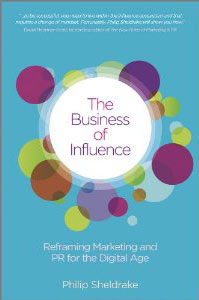
The Business of Influence: Reframing Marketing and PR for the Digital AgeThe Business of Influence is a rethink.

It's about improving the capabilities of organisations to design and attend to the way in which all aspects of its operations influence stakeholders, about making sure stakeholders influence it, systematically, and about how well competitors are attempting the same. It focuses on influence as the common denominator of marketing and public relations and related activities such as customer service, sales, product development and HR, and therefore the basis for redesigning these and interconnecting them.

The book introduces the Influence Scorecard, named in homage to the dominant framework for business performance management, the Balanced Scorecard. The Influence Scorecard then is a subset or view of the Balanced Scorecard containing all the influence-related key performance indicators (KPIs) stripped of functional silo, and it may extend beyond the Balanced Scorecard should a greater operational granularity of metrics be demanded by the influence strategy.

The Influence Scorecard is a new framework for the 21st-century designed to help organisations focus on what matters rather than continue to carry the baggage and inefficiencies that come part and parcel of the typical 20th-century marketing and PR structure and approach. It's a reframing in the context of 21st-century media and disintermediation, 21st-century technology, and 21st-century articulation of and appreciation for business strategy. Read more

What’s the ROI of social media?

I was delighted to have the opportunity to present my take on the ROI of social media to approximately 80 people yesterday evening at the Digital Publishing Forum. It seems this was a hot topic of interest; as well it should be.

I sought to put the topic into perspective with the following challenge. What's the ROI?...

  • Of the latest rebrand?
  • Of the office refurb?
  • Of the internal communications activity?
  • Of the training and development programme?
  • Of the upgrade to Windows 7?
  • Of the new standard issue smartphones?
  • Of the stakeholder engagement via social media?

If you'd like to see where we went from there, here's the presentation:

Thanks to Julia Lampam (@JuliaLampam) for the invitation to speak.

Influence in the age of the social web – keynote to EUPRERA

It's a beautiful sunny Spring day here at the EUPRERA Spring Symposium in Lisbon. It's my first time at this gathering of the European Public Relations Education and Research Association – the forum for innovative PR research and education – and I'm delighted to have been invited to deliver the keynote.

Thanks to Philip Young and David Phillips for the invitation. Here's the slidestack. I was a bit surprised to get a slide count of 77, but 16 of the slides present the infographic 'Content – An illustrated history', which is easy to breeze through :-)

Real-time PR demands rigorous strategic alignment

Real-time PR is a hot topic.

This is nothing to do with fashion, but the unavoidable pressures of modern PR. David Meerman Scott's November 2010 book, "Real-time Marketing and PR" is already a Wall Street Journal bestseller, and with Twitter responses frequently meaningless after an hour's delay, if not minutes, and many conversations requiring a response within the hour or two, awaiting the Monday meeting to debate possible responses is now simply unrealistic.

I presented at Social PR 2011 today on just this topic. The main take home... it isn't easy.

Being the eyes, ears and mouth of an organisation to the drumbeat of the daily news was never easy. Being the eyes, ears and mouth, with heightened sensitivity to influence and be influenced in real-time, requires enhanced levels of strategic diligence, meticulous planning, training, constant attention to detail and rigorous measurement.

Reality is perception.

It’s impossible to fake it.

Real-time PR must, by nature, be authentic.

Real-time PR marks the death of the persuasion / ‘spin’ school.

Long live two-way, symmetric PR fostering mutually beneficial relationships between an organisation and its publics.