Customer-centricity is an organizational point of view, not a customer point of view. It’s actually the organization-centric-view-of-the-customer.
...
Don’t you want CRM to help you and the customer mutually, allowing you both to manage the relationship? Surely the value of your understanding how influence goes around comes around is enhanced when those you interact with have similar understanding. Or would you rather propagate the status quo – CRM as a construct to manage the customer?
Category: Social business (page 4 of 5)

Stowe Boyd recently published "A Manifesto For A Third Way Of Work" (although the title will change). The manifesto forms the basis of the book Stowe plans to write throughout 2014, crystallizing the perspectives and insight he has forged and assembled over the years. And if you've read Attenzi – a social business story then you'll know Stowe and I think alike on many matters.
[Update 20th March 2014: the title changed to A Manifesto For A New Way of Work.]
Here are the major theses, and I have identified with an asterisk the four I have chosen to argue below.
Dissensus (versus Consensus)
— active and directed dissent is a better way to counter the cognitive biases of groups and individuals, and to sidestep groupthink; essential to increased innovation and creativity truly driving business
Cooperative (versus Collaborative)
— sidesteps the politics and collectivism of consensus-based decision-making, and shifts to looser, laissez-faire cooperative work patterns
Creativity (versus Tradition)
— new solutions to problems are needed, and traditional approaches may not only be broken but dangerous
Autonomy (versus Heteronomy)
— paradoxically, as we come into a time when we acknowledge that we are more connected to each other than ever before, a great degree of autonomy will become the norm; old demands to subordinate all personal interests to those of the collective will be displaced by a personal re-engagement in our own work and a commitment to a deeper work culture that transcends any one company’s corporate culture Read more
Having gone down the traditional publishing route with The Business of Influence (Wiley, 2011), I decided for a number of reasons to try a different route in 2013 with Attenzi – a social business story. Most of those reasons boil down to one simple fact, the publishing industry isn't yet embracing social business principles. In fact, it's perhaps a prime example of an industry continuously trying to manipulate the application of 21st Century technologies to maintain the 20th Century status quo.
 I appreciate that cannibalizing ones own livelihood is never an easy journey (heck, even management consultancies find it tough), but I figure it's got to be worth attempting when the alternative is so bleak. I'm hardly the first to levy such criticism (crystallized beautifully in The Innovators' Dilemma of course), but here's a prime example in my particular case.
Quite clearly, I'd love to stimulate conversation and debate about social business – after all, collaboration and co-operation cannot spring forth without first conversation and sharing. So the ebook formats of Attenzi feature hyperlinks at the beginning of each chapter taking readers from the ebook to the HTML version where they can coalesce to comment, to ask and answer questions, to share resources, as they wish. And share hyperlinks to pages of the book wherever they hang out.
That means the whole book needs to be available in HTML – the global, open standard for the presentation and mark up of documents, <sarcasm>lest anyone from the publishing world require an explanation here</sarcasm>. This in turn means traditional copyright terms would be violated, which means I couldn't work with traditional publishers.
I appreciate the economics here don't apply to all authors or all published works, but as both Doc Searls and JP Rangaswami note, I will derive more value personally "because of" the ebook than "with" the ebook. I have secured two projects during the past six months on the back of releasing Attenzi unfettered, creating revenues far in excess of any I would have derived from traditional royalties. (Note: my writing doesn't achieve Harry Potter levels of readership!)
So I have lived up to the principles of social business, and profitably.
Should any publisher wish to have a conversation about business models for B2B publishing, please get in touch. My network of associates and I have plenty to contribute.
We've all done it.
It doesn't matter if you're a professional data driven content marketer, or some poor soul who's been told to conjure up the December post for the company blog, the temptation to write that post about the looming New Year is, well, too tempting.
If you're looking for real link fodder, best include a call to action and sell the idea that something may be learned and put into valuable action before Santa boots up Google Maps, post title bait such as:
Planning for social media ROI in 2014
(but the true value of social isn't quite so straight forward)
14 social predictions that will transform your organisation in 2014
(or read Attenzi)
Your New Year Resolution – Simplify the Complexities of Social Media
But when you think about 2014, ask yourself what's in a year? "The period it takes the Sun to complete one course throughout the zodiac along the ecliptic" says Wikipedia. And as I ask in my Attenzi story: "Why are the frequency and duration of our plans linked to the time it takes our planet to complete a particular cycle around the Sun? What’s 365 days got to do with our business exactly?"
If you champion social business you champion agility, responsiveness and adaptability. Not the annual planning slog.
More often than not I get shouted down for being short-termist at this point. Yet I believe a long-term vision remains as critical to business success as ever, but flexibility (finding a new course to execute the strategy; operational) and agility (recognizing when the strategy needs adaption; strategic) are business critical too. We're talking about the facility to take complexity into account.
Stowe Boyd goes even further. "The fast-and-loose business that is emerging as the new way of work runs more like a forest or a city than machinery. We need to learn by imitating rich ecosystems, where the appearance of chaos yields to emergent order, and reject order imposed by design." I love this outlook but don't subscribe to it in extremis.
Either way, the most interesting New Year's Resolution you might make for your organisation in 2014 is to make it your last.
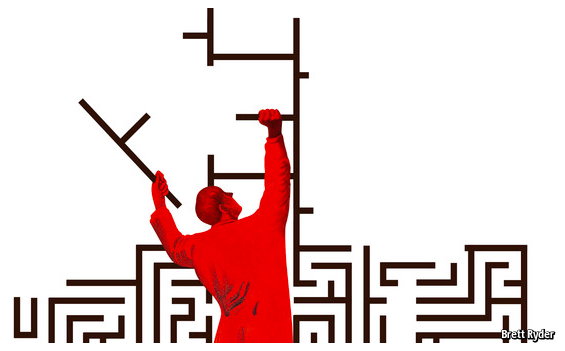
The Schumpeter column in The Economist got it wrong: "It's complicated. Management thinkers disagree on how to manage complexity." The column comments on the recent 5th Global Drucker Forum – Managing Complexity and describes organizations as having two choices, deal with complexity or simplify.
Those that deal with complexity "may look complex and unwieldy but they have an inner logic and powers of self-organisation." In contrast, "the second, rival solution to dealing with complexity is to impose simplicity."
But to present the situation as 'either / or' is simply misleading, and I think it comes down to a failure to appreciate the critical difference between complexity and complication, a difference that must be well understood when redesigning the way your organisation works. Read more
Published as a guest post on briansolis.com, Friday 8th November 2013, in response to Chris Heuer's post "Social Business is Dead! Long Live What’s Next!"
As he finished a game of Cut The Rope on his iPhone, my young godson asked what my phone was like when I was his age. I broke it down for him. I was in my twenties before someone offered to take north of ten thousand dollars for a basic digital camera, and not much less for a GPS device. And I got my first basic mobile phone (I explained that means just making phone calls and sending text messages) as I approached thirty.
A few days later, as she dispatched her umpteenth snapchat of the morning, my niece asked me why I obviously enjoy what I do for a living. Imagine a whole lifetime, I replied, during which the only innovation was a tweak to the angle of the plow shear.
Scientists and engineers have been good to us. We’ve come to expect serious technological innovation with the regularity of the seasons. So, just like Chris Heuer, I’m more than ready for corresponding organizational change.
Now.
As in right now!
Having reflected briefly on the vast progression of the Internet and the web, computing, mobile infrastructure and social media services – as if you needed a reminder – let’s look at what’s changed at the typical organization during this time, my adult lifetime. Or more pertinently what hasn’t. Read more
[Edited 7th October to embed the event video and move the slidestack to the end.]
I've been hosted by 3M today in Minneapolis St. Paul, and what great hosts too... a fantastic team and an incredible company heritage to boot. I could have spent a whole day exploring the Innovation Center, which is so well done I'm sure it brings out the geek in just about everyone.
Gregory Gerik is 3M's transformation social media leader, and he led the design and delivery of the 3M ThinkTANK conference today. Kicked off beautifully with a keynote by Brian Solis, we've been provoked, informed and entertained by: Read more
The first edition of Attenzi - a social business story was published May 2013. And I'm delighted that today sees the publication of the second edition in association with Social Media Today.
Joining the original foreword by Microsoft Yammer co-founder and CTO, Adam Pisoni, is a new foreword by Social Media Today founder and CEO, Robin Carey. The book also has a new front cover and an additional chapter.
I'm in Atlanta today and for the next couple of days for Social Media Today's inaugural conference, the Social Shake-Up. If you're coming, do say hi. And as Robin says in her foreword, "Attenzi makes perfect reading for the flight to Atlanta, or indeed the flight home." :-)
I'm kicking off #SCRM13 in London this morning. SCRM stands for social customer relationship management, and my role today is to get some energy into the room and, hopefully, encourage delegates to look up from simply slapping "social" onto business as normal.
Unfortunately, that's precisely what many have been charged with doing. Those with appropriate powers of persuasion will effect organizational change I'm sure, but more to the point I feel that more chief executives need to attend Luke's conferences, a sentiment I'm sure he'd endorse.
I'll finish this short post with a quote from one of the characters in Attenzi - a social business story, chapter 60 (they're short chapters!)
"Don’t you want CRM to help you and the customer mutually, allowing you both to manage the relationship? Surely the value of your understanding how influence goes around comes around is enhanced when those you interact with have similar understanding. Or would you rather propagate the status quo – CRM as a construct to manage the customer? Who do you think best knows the customer in the round today anyway – you or him?"
[Also published on Microsoft's #bizremagined website.]
I’m fascinated by innovations in the language of innovation. Is it the inclinations of the innovator or the characteristics of the innovation that suggests new words and phrases? When and why is existing lexicon deemed inadequate? Why do we embrace some expressions yet others wither and die?
A quick browse at netlingo.com turns up such beauties as advermation, mouse potato, and idea hamster. All new to me, and for all I know dead already. I had a go a few years ago with Internetome to describe the physical manifestations of the Internet of Things, and let’s just say the word hasn’t made the Oxford English. Yet.
Enter the phrase “social business”, bandied around with increasing frequency. What is it exactly?
Well perhaps this particular turn of phrase is sufficiently nascent to mean different things to different people. The candidate meanings form a spectrum to my mind, with “an organisation that uses social media” at one end (with the hashtags #socmed and #socbiz used interchangeably), and a deep, transformative opportunity at the other. Whether or not such a profound transformation ends up being labelled social business, we’ve tried hard at Euler Partners to articulate what it might mean in less ambiguous terms. Read more