Category: Social business (page 3 of 5)

Fancy a coffee? Social business and your non-solicitation terms

Department of Coffee

The recent antitrust lawsuit against Apple, Google, Adobe and Intel for collusion in hiring practices demonstrates a lack of respect for the respective organisations' employees. Fundamentally, how dare one's employer collude with another in ways that may limit one's career progression!

Having been an employer carrying the not insubstantial costs of hiring I know how difficult it is to watch someone in whom you have invested considerable time, money and energy walk out the door, but I think my memory serves me well when I say we encouraged the team to celebrate such departures. If anything, our alumni network grew +1 each time.

When you define social business as I do, what might the clause for "non-solicitation" look like in your terms of business? How about this:

We believe our employees should be free to do whatever they consider best suits them. We do not therefore seek to apply any restrictions on their future employ. Their success is our success.

If such a declaration is representative of your wider values, you might find loyalty actually improves. By investing in our culture and award winning training and development, we felt comfortable wishing leavers the very best for the future. It felt right and served us all well.

[Image credit: Department of Coffee and Social Affairs – a fine selection of London coffee shops in which to have such conversations.]

The efficiency fallacy in the #responsiveorg context

responsive v efficiency
I'm at the #responsiveorg unconference in London today, and I'm on the hunt for dissensus rather than the echoic chamber of the converted preaching to the converted, as warm and lovely as that feels. So with that in mind, let me kick the tyres of one of the primary assumptions underpinning the #responsive org manifesto.

From Efficiency to Responsiveness – Historically, competitive advantages came from optimizing for efficiency and labor productivity of standardized product, with companies such as Walmart and Ford being common examples. As the flow of information increases, the competitive advantage is held by the organization that can react the fastest to new information. Companies achieve increased responsiveness by reducing the friction of information flow, increasing their iteration rate, decreasing their cost of failure, and optimizing their structures for adaptability.

This I like. I don't however agree that this means we should face-off efficiency and responsive (the main image heading this post is taken from the current #responsiveorg slideshare, embedded below fyi). The following table, which coincidentally featured in my very last post (Doing the triple loop – profound leadership), expains why:

Read more

Doing the triple loop – profound leadership

Gandhi

Drucker

Peter F. Drucker asserted: "What's measured improves." I'm a sucker for measurement and organizational learning as you can see from the posts tagged as such here – perhaps it's something to do with my engineering training.

I advocate tapping extant business performance management process to effect the evolution towards social business (on this blog, on briansolis.com, on stoweboyd.com, in the Balanced Scorecard Report), and that means getting to grips with the Balanced Scorecard and similar approaches.

The lexicon of performance management often involves so-called single-loop and double-loop learning, but a third loop gets less airtime in my experience. So as we debate the types of organizational design conducive to the potential and aspirations of social business – in the Future of Work, Responsive Org and Enterprise 2.0 communities for example – I thought I'd post the following table outlining ways to think about the loops.

Read more

Enterprise social networks and assimilation – resistance is futile

i want to borg
Enterprise social networking is perfectly suited for the so-called onboarding process.

I say so-called because no dictionary I have lists the word, which is sort of at odds with the fact that they do list the rather unlovely deplane. But I digress. I heard this same claim from Jive, SAP (Jam) and IBM (Connections) at a Eurocloud event last week courtesy of Alan and David @agile_elephant.

It seems academics prefer the phrase organizational socialization, defined as:

a learning and adjustment process that enables an individual to assume an organizational role that fits both organizational and individual needs. It is a dynamic process that occurs when an individual assumes a new or changing role within an organization.

I've been onboarded. Into the Mars way back in the day. Mars prides itself on high performance enabled by a strong culture, and boy were my colleagues keen that I got that culture.

The presentations last week (rather than my time at Mars, promise) prompted me to look up the Wikipedia entry for the Borg, the reason for which will become obvious by reading this if you're unfamiliar with the species: Read more

Employee advocacy – rather uncomfortable and somewhat forced

red arrow
I described the relatively recent concept of employee advocacy in my last post as "rather uncomfortable and somewhat forced", and I've been asked to qualify this description.

Firstly, it's worth stating the obvious – the aspiration that employees might advocate the employer is hardly a new idea. But this relatively new desire to go about it more systematically is prompted by employees' increasing social media activity. While recommending an employer down the pub leaves no discernible trace, doing so online does, and that appears to have internal comms, HR professionals and social media types hot under the dollar.

But here's the rub. Genuine employee advocacy remains a consequence. That's always been the case and will always remain so.

You can't insist. You can't take control of employee social media profiles. You can't pick out people for failing to advocate, not without creating the kind of culture that's counter to employee advocacy.

There’s influence in everything an organization does, and sometimes in what it does not do.

The organization (a collection of people, mostly employees) influences the participating individuals (mostly employees) who influence those beyond the payroll. The culture and policies and behaviours that sway whether that influence is constructive or destructive play out long before Fred lets fly on Facebook and Tina trills on Twitter. Read more

Organization and personal reputation – from first principles to distributed autonomy

Singapore harbour at night
I'm no etymologist but it seems the verb organize appeared in the 15th Century a few decades before the noun organization. Sometimes we forget that the organization, in terms of the institution or firm, is merely a means to an end, and putting legal entities to one side for the moment, an organization is simply a group of people organized around a common purpose.

Reminding ourselves of such first principles is useful when considering how we might create and nurture new forms of organization and how we might improve the current dominant ones.

Jumping forward over 500 years, let's get bang up to date on so-called social business, aka Enterprise 2.0, aka Responsive Organization, aka Future of Work. The question that concludes Attenzi - a social business story exemplifies the new vista:

Do you help all the individuals associated with your organization (employees, customers, partners, suppliers, shareholders, etc.) build worthwhile relationships with each other and others, coalescing by need and desire, knowledge and capability and shared values, to create shared value?

The verb coalesce conveys the facility to combine, and so the facility to recombine, and re-recombine. The coalescence remains for just as long as shared value is created, and created faster than a new combination might afford. Such process appeals to free marketers for whom efficiency and utilisation are front of mind – after all why should resources be tied up in one combination when they can add greater value faster deployed in another? And there's equal appeal to those on the left of the political spectrum who champion self-management and occupational autonomy.

Relationships

Sometimes I define social business as relationships at scale, and not just in the CRM 1.0 way:

Good business is about cooperative and interdependent relationships, always has been, yet the humanity was lost when organizations scaled way up during the 20th Century. We want to make those relationships more human again, but the answer can’t be to scale it all back down. We have to scale something else up.

Read more

Organizational performance – a private conversation that should have been public and is now

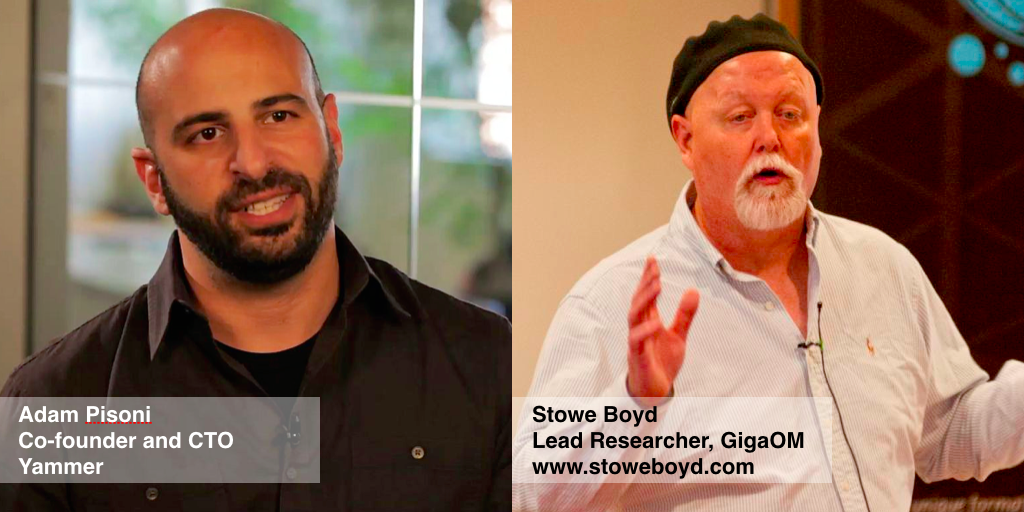
Adam Pisoni and Stowe Boyd

This is a conversation between Adam Pisoni, Stowe Boyd and me relating to a guest post I made to Brian Solis' blog, Impatience is a Virtue – What's Next for Social Business.

The conversation played out on email, which is ironic given that all three of us advocate "working out loud" unless confidentiality precludes it. I take the blame for emailing in the first place and hope to make up for the transgression by publishing it now. I have removed those conversational niceties that pepper emails, inserted some helpful hyperlinks and comments in square brackets by way of explaining some of the terms used and topics raised, and tweaked a few things to improve readability here.

[Photo of Adam by Intel Free Press. Photo of Stowe by Paul J Corney.]


Adam

Honestly, one of the most enlightening aspects of finally working within a real, big enterprise [Microsoft acquired Yammer in 2012] is the affect of performance management and budgets. Yammer loved to yell at our large customers to just change how they worked. That anyone at any level could affect change. But what you see inside large companies is that really good people will do all the wrong things either because they eventually feel pressured to optimize for what they are incentivised to do, or because their scope of power is too narrow to affect any change. This happens with budgets all the time. Two people in different parts of the org may have an idea that could make the company lots of money, but since the budgets were set up a year in advance, they can't shift the money between them. Read more

The social business mutuality stack

Sun horizon

Can you tell by looking at a photo like this if it's of a sunrise or a sunset? Absent knowledge of the time of day or the direction in which it was taken, I think not. Just as well I'm talking about both a start and a finish here then.

Sun-setting

First, the crap that's finishing – that would be public relations as spin. That would be lying, or inauthentic manipulation at best. That would be attempting to build and maintain a façade in the vain hope that customers, employees, investors and partners, present and future, confuse the façade for the real thing. As the saying goes, you can fool some of the people some of the time, but not so many for so long now that everyone packs a smartphone.

Enough has been written on this topic for me to hope that you'll agree, or at least concur the trend is well established. As one of my characters in Attenzi points out:

If ‘perception is reality’ was the saying that characterized our approach to marketing and public relations before, we now have to consider that reality is perception.

Sun-rising

When I first learned of the excellence theory of public relations I was immediately attracted to it. What's not to like? It's constructed on the basis that we use communication to negotiate with the public, resolve conflict and promote mutual understanding and respect between the organisation and its stakeholders. It describes a management function focused on this two-way communication to foster mutually beneficial relationships. Read more

Toward a Model of Work Redesign for Better Work and Better Life

Leslie Perlow

Toward a Model of Work Redesign for Better Work and Better Life (PDF), abstract:

Flexible work accommodations provided by employers purport to help individuals struggling to manage work and family demands. The underlying model for change is accommodation – helping individuals accommodate their work demands with no changes in the structure of work or cultural expectations of ideal workers. The purpose of this article is to derive a Work Redesign Model and compare it with the Accommodation Model. This article centers around two change initiatives – Predictability, Teaming and Open Communication and Results Only Work Environment – that alter the structure and culture of work in ways that enable better work and better lives.

Leslie A Perlow, Erin L Kelly, Work and Occupations, 2014 41: 111, DOI: 10.1177/0730888413516473

Photograph of Leslie Perlow. Source, Harvard Business School.


I posted recently about my experiences curating a Flipboard magazine. One dislike is the inability to 'flip' a URL for a PDF. So in this instance, I've created this post for the sole purpose of flipping it to Social Business Design magazine.

If you missed the link to the PDF above, here it is again.

“Our goal is to become a social business but how do we get the revolution started?”

revolution Ukraine demonstrators

During a deep and meaningful conversation recently, my interlocutor declared:

Our goal is to become a social business but how do we get the revolution started?

This post addresses two problems integral to this statement.

A means not an end

Social business is a fairly fuzzy concept at the best of times. Some consider it synonymous with terms such as Enterprise 2.0, Agile Business, Responsive Organization, and Future Work, whereas others more deeply invested in any one may argue the differences. For the record, I describe social business by way of the following challenge:

Do you help all the individuals associated with your organization (employees, customers, partners, suppliers, shareholders, etc.) build worthwhile relationships with each other and others, coalescing by need and desire, knowledge and capability and shared values, to create shared value?

Shared values

Some pundits prefer to talk about shared purpose rather than shared values, and I think this may well be akin to Stowe Boyd differentiating between collaboration and cooperation with shared purpose relating to collaboration and shared values relating to cooperation. In his words: Read more