Archives (page 8 of 43)

Introducing the hi:project

hi-project blog post header
The hi:project launches today. It's a synthesis of many of the things I care about, from the original decentralizing visions for the Internet and Web, the aspiration that digital technologies can help people relate to each other better and understand each other better, and the idea that we might connect to each other without wondering who's monitoring our every action.

I believe that making all variety of organization more agile, more valuable, more useful starts by empowering all the individuals that play a role in the organization's success. The creation of mutual value begins with acquiring self-knowledge and mutual understanding to effect mutual influence, and this is exemplified by the question that concludes Attenzi - a social business story:

Do you help all the individuals associated with your organization (employees, customers, partners, suppliers, shareholders, etc.) build worthwhile relationships with each other and others, coalescing by need and desire, knowledge and capability and shared values, to create shared value?

Are we really going to answer this question satisfactorily by having everyone interface with the digital world similarly? By having them come to each machine in turn than have the machines come to them? I think not.

Introducing the hi:project. I hope you'll join in.

How is PR changing and who’s going to do it?

Padrão dos Descobrimentos, Tagus River, Lisbon
I've had a number of questions thrown at me by students in their dissertation deliberations these past weeks. I'm not going to post them all here as there is overlap as you can imagine, but this one complements nicely the Q&A with Phillip Casey (and here) at Newcastle University.

Silvana Paules

Silvana Paules

Silvana Paules is a post-graduate student undertaking a Masters in Strategic Management of Public Relations at the Higher School of Social Communication, Instituto Politécnico de Lisboa. (I took the main photo here on a trip to the Instituto Politécnico in 2011.)

Here are the answers I offered to some of her questions, and I start with a relevant extract from Chapter 10 of The Business of Influence.


The Chief Influence Officer (CInflO)

The incumbent [of this role] is charged with making the art and science of influencing and being influenced a core organizational discipline – charged with executing the Influence Scorecard. They will be keen to network with peers in other organizations, to share best practice, to identify, refine and codify proven techniques, and to flag up unseen or unanticipated flaws in the processes described in this book [and others].

In my opinion, the role of Chief Influence Officer will be regarded as being on a par with the COO, as CEO-in-waiting.
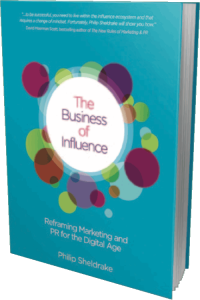
The Business of Influence, Sheldrake, Wiley, 2011Ideally, the Chief Influence Officer will have a varied background covering marketing, PR, customer service, HR, product development and operations – just the kind of trajectory frequently mapped out for ‘future leader’ types. They will probably have more experience in one or more of these over others of course, but will set out as a matter of urgency to orient themselves in the areas of the organization with which they have least experience, working hard to establish a thorough and lasting rapport with functional heads and all stakeholder groups. They will excel at interpersonal communication, inspire confidence and a can-do attitude, and know instinctively when to crack resistance one-on-one and when to draft in support from the CEO.

Given the not inconsiderable change management, collaboration and coordination challenges, boards will look in-house for candidates with extant strong organization-wide interpersonal relationships and a reputation for making change happen from both the hard and the soft side of things. Appropriate candidates will recognize that the task is not achievable alone, particularly without unanimous and unequivocal board support – which they will be intent on working hard to secure, if not already manifest by his or her appointment.

The candidates will be highly numerate, probably having taken a statistics or research methodologies component to their university degree.

They will be ‘digitally native’. They will be curious and indefatigable by nature, and able to identify and exploit opportunities as rapidly as they identify and learn from failure.

They will be comfortable living simultaneously in both the extreme, unrelenting real-time, and the future two to four quarters hence.

[...] They will particularly relish the harsh, unflattering light thrown on previously opaque and unconnected aspects of the organization, and the boardroom accountability this allows them to enjoy and demands they live up to. Read more

More questions of influence – size and complexity

https://www.flickr.com/photos/martinlatter/5576004597/ BY-SA
Phillip Casey, post-graduate student at Newcastle University, follows up our earlier Q&A with a couple more questions.

Is influence harder to manage as an organisation grows in size?

As before, beware the idea that influence can be managed per se. I'll assume you're referring to the considered design and monitoring of process, culture and operations more widely, to increase the likelihood that stakeholders are influenced and appropriate reciprocation is encouraged, in ways more conducive than otherwise to the organization achieving its goals and living up to its purpose.

Complexity of the influence system does tend to increase with organization size from my observations, and possibly by definition. But I'd caveat that by asserting that such observation should demand a response in organization design terms. Read more

“We called it influencing the influencers.” Adobe. Late-80s.

Adobe influencing the influencersYou have been influenced when you think something you wouldn't otherwise have thought, or do something you wouldn't otherwise have done.

In the 20th Century, the marketing department did marketing, the PR people did PR, and no job title included the word influence. To this day, no role or team or department in the typical organization incorporates the word, which is why I pivot my client workshops around the topic of influencing and being influenced – not only does it address the actual thing we're all interested in, it helps lower ego defence and removes functional blinkers.

Only very recently are organisations looking up from the typically too-narrow focus of PR, which for some reason appears to have restricted itself to media and analyst relations of recent times, and looking away from the pay-to-spray-and-pray domain traditionally occupied by the bods in advertising, to investigate the effectiveness of so-called influencer marketing.

While this is just a sub-domain itself of the deeper and wider influence system, I thought, given this trend, you might find the following 30 seconds of video interesting. It documents the efforts Adobe Systems went to towards the end of the 1980s to get its Illustrator software accepted.

We called it influencing the influencers.

Learning to measure and measuring to learn

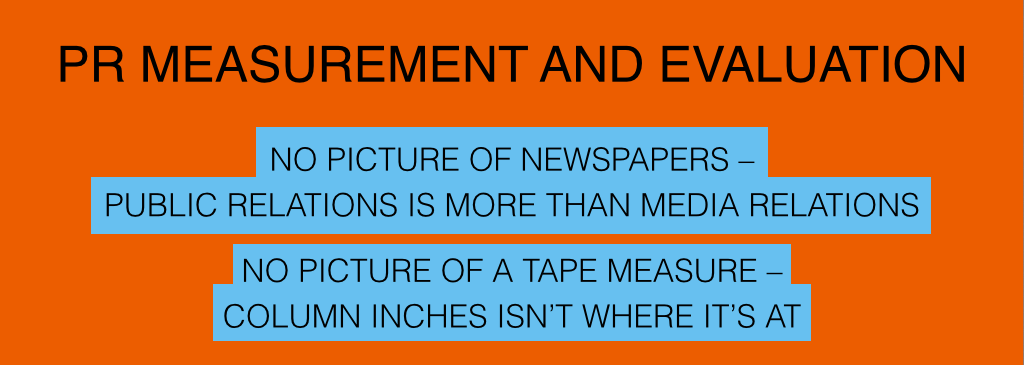
PR measurement and evaluation
The CIPR is in the process of updating its research, measurement and evaluation guidelines (PDF). The current edition is dated March 2011 and harks back to when I used to chair the CIPR's measurement deliberations; the current initiative is being led by Matt McKay and Martin Turner.

Here's a short but important extract from the current guidance:

Every organisation should have a mission (why we exist), values (guiding behaviour), a vision (what do we want to be), objectives (breaking down the vision) and strategy (how we intend to get there / achieve the objectives). Given that measurement isn't just the detached collection, analysis and presentation of data but a powerful management tool in itself, a powerful way to align each employee’s day-to-day activities with the strategy, this cascade must continue robustly, transparently and visibly.

People perform as they are measured, so the measures must drive strategically important behaviour.

And as each marketplace is unique and as your organisation is unique, your strategy will be unique. And so, therefore, will be the suite of measures you design, deploy and manage by.

Read more

Brand, PR, non-profits, and responsiveness – Q&A by Phillip Casey

Armstrong Building, Newcastle University
Having put my two penn'orth out there over the years I'm occasionally approached by students at this dissertation time of year. This week, Phillip Casey and I struck up conversation on Twitter. Phillip is a post-graduate student undertaking the MA in Media and Public Relations at Newcastle University (pictured) and his dissertation is titled Brand Image: PR in the UK non-profit healthcare sector.

Phillip Casey

Phillip Casey

I enjoyed responding to Phillip's questions, so, with his permission, I thought I'd make our Q&A public here. (It migrated to email in case you were wondering about a 140 character count.)

Where a reference consists of just a page number, it refers to The Business of Influence: Reframing Marketing and PR for the Digital Age.

1) Is a strong brand image important for a non-profit organisation? Why?

A brand used to convey ownership of livestock. Then it was an "our name's on it" quality assurance. This century, with product quality (defined as fitness-for-purpose) increasingly a given, a brand represents a nexus of values. If our values align with a brand, then I'm part of that brand. If they don't, I look to take my time, attention and money elsewhere. [Attenzi]

Organisations need to communicate their purpose and values in order to attract and assemble the right mix of people and resources to live up to its mission and pursue its vision. So brand, defined like this, lies at the heart of things. Read more

The blockchain is coming your way

Bitcoin index 21 July 2014

Bitcoin is the most famous cryptocurrency with the highest capitalization. As you can see from this screenshot from the "block reader" blockr, the capitalization at the time of writing is over eight billion dollars. According to citations of an IMF report on Wikipedia, that places it just above Moldova's GDP.

This post isn't about bitcoin but the cryptographic foundation of Bitcoin. (The community prefers to capitalize the word when referring to the system, and lower case when referring to the currency.) This post doesn't explain Bitcoin or the blockchain in detail – I recommend this series of presentations courtesy of the Khan Academy for those who want to learn more – but rather it's about the technology's wider application and its emergence and growth beyond the early adopters.

Get this into your block

So why am I interested in Bitcoin specifically, and its blockchain foundation more broadly? What does this have to do with social business?

We are contemplating blockchain platforms to enable decentralized consensus in the not too distant future, allowing us to codify, decentralize, secure and trade many things that historically have demanded some centralized facility. This is akin to the bitcoin currency functioning without the need for a central bank, and the vista includes voting, domain names, financial exchanges, crowd funding, organizational governance, intellectual property, contracts and agreements of most kinds. The landscape even extends to so-called smart property with appropriate hardware integration.

Sometimes I wish I was more of a wordsmith, but this word will have to suffice – wowzers! Read more

Deliberate and emergent, by design

crab sand

I've been trying to reconcile the apparent tensions between the deliberate and emergent strategy schools of thought. After all, it's a fundamental question at the heart of organizational life today.

Defining deliberate and emergent strategy

The deliberate strategy process is the one with which most people are most familiar if only because it dominated 20th Century organizational life and still does. A senior team reviews the market, the trends, the SWOT, the fruits of R&D, etc., and formulates strategy – where to play and how to win – that the wider organization is then charged with executing. And based on nothing more than atavistic agricultural habits that are now largely irrelevant, we exhibit a predilection for going through this process with a calendar based drumbeat.

Emergent strategy adherents on the other hand insist that such practice is pure fancy. It's divination beyond the realm of even the most cogent, gifted and able senior leadership team. The deliberate strategy process supports C-title egos and little else. Rather, we're better off making the organization sensitive to even the slightest changes, the weakest of signals, and developing an organizational fabric with the agility to react appropriately, to exploit opportunity and close down risk. Read more

Taxi! Hailing a ride, but not too far into the future

yellow cab new yorkThe controversy Uber is causing right now prompted me to delve into the archives. Way back. Back to March 2000 when I was pitching a proposition called Peoplestaxi to the likes of 3i and Avis. It got selected for First Tuesday's "Wireless Matchmaking" events too. Here's a quick extract:

Peoplestaxi leverages the latest technologies and customer-centric e-business philosophy to deliver the ubiquitous, convenient and intelligent taxi management service for business and consumers.

... Bookings are accurate and quality is assured. Punctuality, customer relationship management, personal safety, event critical booking, full account management, multi-payment methods and community grouping are all delivered automatically, seamlessly and brilliantly.

... As Peoplestaxi restructures the taxi market, existing taxi firms will have to affiliate, find some niche or eventually die.

I'm chuffed that I managed to reference the future collaborative / sharing economy in there – "community grouping" – but perhaps that last sentence was the choicest bit of crystal ball gazing.

So how come this didn't become Uber? In short order:

  1. Smartphones hadn't been invented
  2. GPS units still cost a thousand US
  3. Oh, and the dotcom bubble burst just then, spectacularly.

I learned that the first aren't always first. The timing of disruption is a function of the disruption.

Important – the Internet is changing to a new protocol

strips of light

The Internet has transformed the world. Period. I think it's important then to help everyone understand what it is exactly. I'm not talking degree-level understanding of computer networking, but a feel for the kind of thing going on 'under the hood'.

This post explains the new numbering system for the Internet – fundamental for the continued health and prosperity of the Internet this century – and does so without the reader needing any prior technical understanding. There's an executive summary if you only have two minutes. And then more detail if you fancy. It describes what your organization needs to be doing and why.

Most of the post is based on a document I wrote under the auspices of the Department of Business, Innovation and Skills (BIS).

So let's get stuck in. Firstly, allow me to differentiate between two terms too often and erroneously used interchangeably.

The Internet and the World Wide Web are different things

The Internet emerged in the concluding months of the 1960s. The World Wide Web on the other hand, like many other protocols, 'runs' on top of the Internet, and first twinkled in the eye of Sir Tim Berners-Lee in 1989. Read more