Archives (page 41 of 43)

Apple provides media training collateral

What better way to communicate the DOs and DON'Ts in a media training class than by example. Here's one for your training collateral. It is an extreme case; I mean how dare anyone mention Apple iTunes and monopolistic behaviour in the same question?!


Philip Schiller, Apple’s Senior VP of Worldwide Marketing is featured being interviewed by Channel 4 in the UK.

The interview is brought to a rapid close when the interviewer asks "Are you acting in a sort of monopoly way?".  Schiller can't cope with this (whoops, poor media preparation) and looks to his PRs to intercept and take him away from this bad man.

Time

I want to sound you out about time. More specifically, billing, prompted by a recent article in the current edition of Business Week.

And what's happened to Business Week?  I was so confused by the format changes that I decided to Google the reason for it, and we're told the redesign is inspired by the design imperatives of the Web.

But, not being funny or anything, if I wanted Web I'd go to businessweek.com. Surely, if print is threatened by the big WWW, then differentiation is the key to success, not assimilation?

Anyway... time.

The article "Shirking Working: The War on Hooky" focuses, as the title suggests, predominantly on dealing with the relatively modern (as in decades) phenomena of so-called sickies. But there's a quote towards the end from IBM's Dan Pelino on the wider issue of judging-by-results and not the ticking of the minute hand: "Tracking time is passé; we could never go back."  Even Best Buy has adopted an approach whereby "employees are evaluated on their output, not their hours."

How does this translate to marketing communications consultancies?

Whilst I might find a few minutes in the month to chew this over, I was reminded of a blog I stumbled across a few weeks ago by a lady called Sam Ladner who has dedicated years to the subject.  She is undertaking a PhD in "Work, Time and Interactive Agencies", with this preface:

"The notion of "billable hours" makes interactive agencies intriguing places to study work and time. Like law firms, interactive agencies rely on billing their clients for the work their workers complete. This practice -- which requires detailed tracking of hours, projects, and budgets of time -- conflicts with what we know about creative work.

Creative work typically requires focused, intensive, and often undirected time. Where might this fit with the model of billable hours?"

If you have the time, no pun intended, then this post on her blog is a good place to begin to understand her rationale and conclusions.  In short, she feels that "billable hours" are history (oooh, another pun).

If I can try to condense her PhD into a couple of sentences:

1. Time and results aren't linked in creative agency, so the only reason to log time is to demonstrate effort to the client

2. However, all time sheets are inaccurate without exception, and everyone knows it, so time sheets serve to teach workers to internalize billable time, whereby billable is good and non-billable is bad.

I'm going to discuss this with my colleagues and industry contacts and come back with a follow-up post. Love your input if you have any thoughts...

Graphic engagement

Here at Racepoint we've been thinking about the ramifications of one of my previous posts, "Continuous engagement... the death of market research". A particular area of interest is the way in which we might help companies interact with stakeholders other than via text-based media.

Yes, I know there's the telephone too, but following the tenet that restricting the channel can only restrict the quantity and quality of interaction, how else can we reach out and engage?

We have no definite answers yet, but I thought I'd share some of the visual / graphic tools we have taken a look at. In particular, I'd love to know if anyone out there has any experience of or perspectives on this genre of tools.

Sketchcast

The first up is Sketchcast. A simple but unexpectedly enticing (or is that just me?) concept. Here's a sketch demonstrating my artistic capabilities...

Imagination Cubed

An experiment from GE, Imagination Cubed is a simple and compelling service that permits up to three people to collaborate on a diagram.

Gliffy

Adopting a more formal approach than Sketchcast and Imagination Cubed, Gliffy is more of the ilk of productivity software ported to the Web. In this vein, perhaps we can expect similar innovation from ThinkFree, Zoho and Google Docs in the future?


On the defensive with tech marketing

When historians write up 2007, they will surely highlight three things. Of course there's the subprime mortgage disaster and the reunion of the Spice Girls (a subprime pop group?), but my topic here is the mega marketing clash of the huge tech titans.

I've been in tech for some years now, but unless it's a case of the nearer the clearer, I can't recall such furiously fought marketing battles.

The last big battles, by popular concensus, were won by Microsoft's Internet Explorer and Google's search. They appeared to trounce the competition, the first by anticompetitive practices according to the European Union, and the second by peer-beating capability. Do you recall an advert for IE or Google?

But now, possibly as the functional differentiation narrows between competing products and services, the marketing strategy becomes more important than ever. There's increasing emphasis on depositioning, the skill with which one organisation can take the wind out of the competitor's sails.

And that takes me to this afternoon's anticipated Google announcement. Just days before the iPhone is due to debut in markets outside the US, just weeks before consumers consider their Christmas mobile phone options, Google calls a press conference. The message (I think!)... Google owns mobile too.

Now I might be putting my neck on the line here, and we'll know within hours, but I don't think this is the launch of a much-rumoured GPhone, but the official announcement of the very fact that a GPhone project exists and what they're planning. And why? Just to keep the Google momentum going.

With no real success since search (1998) and maps (2005), Google has had to rely on simple World dominance to sustain share of voice; no small thing of course! But, as 9 years have passed since the last major search engine innovation (Google's pagerank algorithm) and as Google makes 80 per cent of its profits from ads served on its search page, they must be nervous that someone could sweep their lead away. Remember Alta Vista? (See Newsweek's "Searching for a better search engine" for an incisive summary of the search market.)

And Google isn't the only example I could have taken here. Microsoft finds itself in a similar position, as do Dell and Yahoo!

There's a lot riding on tech marketing in 2008. Long regarded part of the armoury for attacking a market, it's now needed as much for defence as offence in tech markets.

______________________

Update 18:03 GMT

Yep, Google has announced their new wireless initiative, due second half of 2008.

"SAN FRANCISCO, Nov. 5 — Google took its long-awaited plunge into the wireless world today, announcing that it is leading a broad industry alliance to transform mobile phones into powerful mobile computers that could accelerate the convergence of computing and communications.

Mobile phones based on Google’s software are not expected to be available until the second half of next year...."

http://www.nytimes.com/2007/11/05/technology/05cnd-gphone.html

A press conference with one thing missing

FEMA External Communications... information for job applicants. Please check your answers to the following questions:

Question 1.

On calling a press conference, should you give the press...?

A. at least one hour's notice

B. 17 minutes' notice

Question 2.

If no press turn up, should you... ?

A. postpone the conference;

B. get your co-workers to stand in as journalists in front of the nation's live broadcasting cameras.

How did you do?

If you answered "B" to all questions, please send your CV to the Office of the Communications Director, Federal Emergency Management Agency, 500 C Street S.W., Washington, D.C. 20472.

If invited to interview, you will want to study the following video to see how it's done. You will be tested on this subject matter.

[Guardian coverage]


Continuous engagement… the death of market research

ESPN pulled the plug on their cell-phone product after investing $150m including $40m in advertising. This is precisely the failure market research is intended to prevent. How can business harness customers and prospective customers to improve their hit rate and time to market?

The following simple figures demonstrate the difference between traditional market research and continuous engagement.

There are dozens of differences between the two approaches. Research is ad-hoc or at regular intervals whereas continuous engagement is, well, continuous. Research is one-way, and engagement is two-way. Research is devoid of any direct brand benefit (and research purists will claim this is beneficial) whereas continuous engagement inculcates brand loyalty. Here's a list of the primary differences:

  • Research is ad hoc or regular interval; engagement is continuous
  • Research is one-way (+ prize or payment!); engagement is two-way (mutually rewarding)
  • Research is unemotional; engagement is emotional
  • Research is independent of loyalty; engagement inculcates brand loyalty
  • Research has a tight focus; engagement has a wide focus
  • Research deals with sequential parameters; engagement is multi-parametric
  • Research is designed to achieve statistical confidence; engagement is designed to detect weak signals.

The disadvantages of traditional market research

Ad hoc or regular intervals

  • Your last data set getting on a bit?
  • Trying to read between the lines because the last survey didn’t ask exactly the question you now need answering?
  • Is your market speeding up relative to your research frequency?
  • Do you need to ask new questions, but want to continue trending previous survey data?

One-way

  • What’s in it for your respondents?
  • Ever wondered if they’re answering your questions conscientiously?
  • Are they likely to benefit or suffer as a consequence of the information they share with you?

Unemotional

  • Quite simply, do they care?

Independent of loyalty

  • Ad hoc, one-way, unemotional interaction does not drive brand loyalty.

Tight focus

  • How long can you keep them interested for the remote chance of winning an iPod?
  • Once you’ve collected the demographics, how long remains to get to the crux?
  • By what degree can you change the subject?
  • How many times can you change the subject before their brain starts hurting?

Confidence

After all that, it’s no wonder you need some mathematics to determine the statistical confidence.

Social media

The best way to understand your customers, is to have a relationship with them. Online. On the mobile. In store.

Social media is defined on Wikipedia today as:

“the democratization of content and the understanding of the role people play in the process of not only reading and disseminating information, but also how they share and create content for others to participate. It is the shift from a broadcast mechanism to a many-to-many model, rooted in a conversational format between authors and people".

More simply, we define social media in the context here as:

“all integrated channels through which you can get people discussing you and your market, with each other and with you".

Wide focus

Anything and everything is discussed by your customers in social forums. For each topic, you can choose to interact or just listen.

You can also seed the forums with topics relevant to your business tomorrow, not just today. Test their reaction. Harvest value-added feedback; qualitative and quantitative.

Multi-parametric

Traditional research addresses a limited sequence of parameters, whereas social media can embrace multiple parameters.

Nevertheless, your product roadmap may encompass hundreds of parametric permutations. In this instance, you could chose to present ideas based on “runs" (parameter groupings based on Taguchi orthogonal arrays) to your most loyal and valued social media participants.

Detect weak signals

Weak signals are easily overlooked in traditional research. But understanding how to identify the most authoritative members in your social media, and learning to listen to them, can place you weeks if not months ahead of your competition in timely new product launches.

New skills

Supplanting or supplementing market research with continuous engagement requires:

  • A new strategy
  • An implementation framework
  • New analyses methods
  • Sound corporate performance measurement to close the loop

For and against

Unsurprisingly, there are advocates and detractors from this point of view. Take an interview with Bill Neal of SDR Consulting for example:

"..But I have some real problems with consumer generated media as a source of credible and reliable information. In many ways it combines the worst elements of non-scientific research – self selection and advocacy – both positive and negative.

The information they generate may be true, or not true – there is no way to discern which. Therefore, the information generated by those folks is neither credible nor reliable."

However, this perspective could not be more strongly countered by the assertions made in the Cluetrain manifesto:

"A powerful global conversation has begun. Through the Internet, people are discovering and inventing new ways to share relevant knowledge with blinding speed. As a direct result, markets are getting smarter - and getting smarter faster than most companies.

These markets are conversations. Their members communicate in language that is natural, open, honest, direct, funny and often shocking. Whether explaining or complaining, joking or serious, the human voice is unmistakably genuine. It can't be faked."

OK, continuous engagement may not signal the death of traditional market research, but it marks a distinct and influential turning point; a turning point leading companies are adopting today for competitive advantage.

The Chocolate Box Paradox

There are people who claim to be natural communicators and there are those who struggle to get their point across. Most client teams have a mixture of the gifted and the frustrated – the natural order of things some might say. But this mix of skills in the workplace can lead to basic communication problems that disrupt progress. What we need is a framework to help train teams to communicate effectively.

At work, we have a chocolate box paradox of communications – so many choices but not enough guidance or understanding of how to select. Is it the orange crème or the caramel? Face-to-face conversation or email? The wrong choice can lead to difficulties – lukewarm relationships, misunderstandings, an inability to communicate bad news properly..

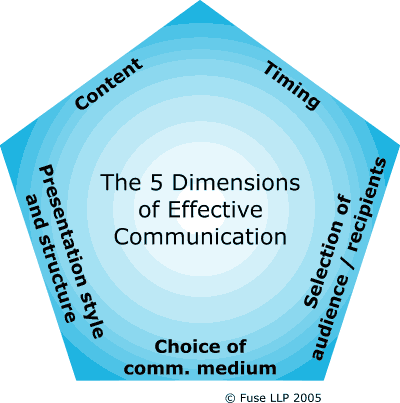
How do we get to grips with these choices? We should start with the dimensions of communication:

5 communication dimensions

Communities and organisations have long grappled with finding the best combination of dimension variables. The (relatively) recent proliferation of communication media has not only increased the choice, but upset previously understood frameworks for effective and successful communication. How many of us complain about not getting enough email? How has Instant Messenger impacted your culture? How many orders have you given via text message?

Training to choose

We have a myriad of choices – but we must understand how to choose the communication medium that best suits our objectives and the objectives of the business. And on to the useful bit: here’s a guide to structuring the core of a training course in selecting the right communication medium for the task at hand. Many of the world's most successful companies run these courses for their employees – so its not puffery – it sits at the heart of their commitment to quality:

  1. Ask your team to identify all the communication media available to them – the variety may well surprise once they are written down
  2. Ask them to identify what factors influence their choice of media – they know when they think about it!
  3. Ask them to work out how each factor influences their choice – a good topic for a lively debate, especially for email addicts
  4. Split them into groups and ask each group to produce a list of half a dozen different reasons to communicate at work. Swap group lists and ask each group to propose a suitable communication medium for each instance – especially interesting when groups coincide with the internal customer - supplier functions, or reporting lines
  5. Ask them to record their findings and formalise recommendations. Photocopy the result, staple or bind, and distribute as the basis for their take home training notes – more relevant to them than some prescribed infliction!

If you are the training owner or facilitator, you can use the following diagram, “The way to say what you have to say”, as a guide or prompt.

The way to say what you have to say

No more hiding behind email..

For people afraid to pick up the 'phone, for those who are blunt on email and blunt their relationships as a result. For those of us who are confrontational or passive, those with confidence and without. Don't underestimate the importance of communication – set guidelines, train your people and measure the results.

Advertising in the Age of Convergence 25th Oct 2007

Part of Intellect's Convergence Conversation series, the next one is on the 25th October 2007 - "Advertising in the age of convergence"...

What is the conversation about?

Advertising in the age of convergence will look at how new technologies are affecting the advertising industry. At a time where internet advertising spend is now twice the size of outdoor advertising and consumer magazines, and three times the size of radio advertising, how will advertisers adapt their strategies and business models to ensure revenue?

What solutions can new technologies provide? How should companies get their message across, now that people consume across platforms, away from broadcast schedules and on the move? All of these questions and more will be addressed by our panel of experts and our interested conversationalists.

Who is leading the conversation?

The conversation will be chaired by Ved Sen and will begin with an experts' take on the market before the debate is opened out. The experts are:

  • John Woodget - UK MD of Intel
  • Jonathon Collett - Director of Communications - The Advertising Association
  • Charlie Horrell - CEO - Packetvision
  • Dean Donaldson - Business Development Manager  - eyeblaster
  • Adrian Swift - Director of Television - etv
  • Nicolas Roope - Co Founder - Poke London

Who can attend?

The experts and the interested.

When and where?

Thursday 25 October 2007, 5.30pm drinks, 6.00pm start, 8pm finish.  From there on, the last Thursday of every month.

Intellect, Russell Square House, 10-12 Russell Square, London, WC1B 5EE.

How do I register?

To register for this event reply to sam.ingleby@intellectuk.org or call 02073312161. To read more about the convergence conversations visit:

http://www.intellectuk.org/policy/committees/cc/default.asp

Sam Ingleby
Digital Communications Programme Manager
Intellect

Russell Square House 10-12
Russell Square
London
WC1B 5EE

T: +44 (0) 20 7331 2000
F: +44 (0) 20 7331 2040
DD: + 44 (0) 20 7331 2161
E: sam.ingleby@intellectuk.org 

NLA, Agency or Anachronism?

I have always admired the UK's Newspaper Licensing Agency for its self-assured composure in freshly applying last century's rules to this one. Now I know rules don't just expire, but equally, they don't just stay relevant untouched, and the legal underpin for the NLA's stance surely demands review. If 2007 marks the year music companies reviewed their attitude toward digital rights management, then it's time the NLA got real too.

But whilst we have been a NLA license holder for many years, it was only from reading a recent email sent by the NLA to a client that I was shocked to see the NLA want their cake and eat it.

Here's the scenario.

Agency X collects the opinions expressed by others about client Y; as any self-respecting PR consultancy would. They scan them for display on an extranet; as any self-respecting PR consultancy would. The client reads them on the extranet; as any self-respecting client would.

Now to many people, this is not a copyright issue. This is not copying original work for the sake of republishing it to the republisher's profit... this is simply logging a public voice contributing to an organisation's public reputation. However, I feel this point is too far removed from the accepted norm to spur support, so you should know this is not the point I'm making. I'm feeling only sufficiently brave to question the NLA's desire to tax us twice. Here's how...

The process described above requires both the agency and the client to have a license.

Now there may be associated activity for which this dual licensing could be justified, but my assertion here is that it appears dual licenses are required for the restricted practice described above alone. Can this be right? Isn't it all just slightly anachronistic? Or, more simply, just a bit nutty!

Global Dynamics event 2nd Nov 2007

This conference looks interesting.  Can't make it myself, but it would be good to hear if anyone else is down to go, and then to get your post-event report.

http://www.resultsinternationalgroup.com/events/global_dynamics.html

Marcoms businesses are looking constantly for new ways to serve their clients, and to grow and develop. The Results International 2007 Global conference explores the latest trends and practices in successfully achieving, funding and managing emerging growth opportunities. Some businesses have chosen the route of international expansion into new or high growth emerging markets; others are targeting new and emerging technologies in the digital space.