Category: Website/New Media (page 4 of 7)

My book, The Business of Influence, is out today

Today's the day!

It's ready for delivery in the UK today, and pre-order in other parts of the world. For those of you tweeting about availability in the US, currently listed as mid-June by some bookstores, Wiley tells me it should actually be with you mid-May. Thank you for your interest and patience.

What's it about?
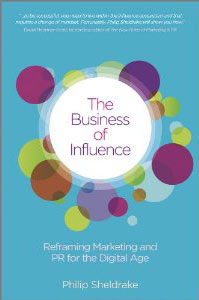
The Business of Influence: Reframing Marketing and PR for the Digital AgeThe Business of Influence is a rethink.

It's about improving the capabilities of organisations to design and attend to the way in which all aspects of its operations influence stakeholders, about making sure stakeholders influence it, systematically, and about how well competitors are attempting the same. It focuses on influence as the common denominator of marketing and public relations and related activities such as customer service, sales, product development and HR, and therefore the basis for redesigning these and interconnecting them.

The book introduces the Influence Scorecard, named in homage to the dominant framework for business performance management, the Balanced Scorecard. The Influence Scorecard then is a subset or view of the Balanced Scorecard containing all the influence-related key performance indicators (KPIs) stripped of functional silo, and it may extend beyond the Balanced Scorecard should a greater operational granularity of metrics be demanded by the influence strategy.

The Influence Scorecard is a new framework for the 21st-century designed to help organisations focus on what matters rather than continue to carry the baggage and inefficiencies that come part and parcel of the typical 20th-century marketing and PR structure and approach. It's a reframing in the context of 21st-century media and disintermediation, 21st-century technology, and 21st-century articulation of and appreciation for business strategy. Read more
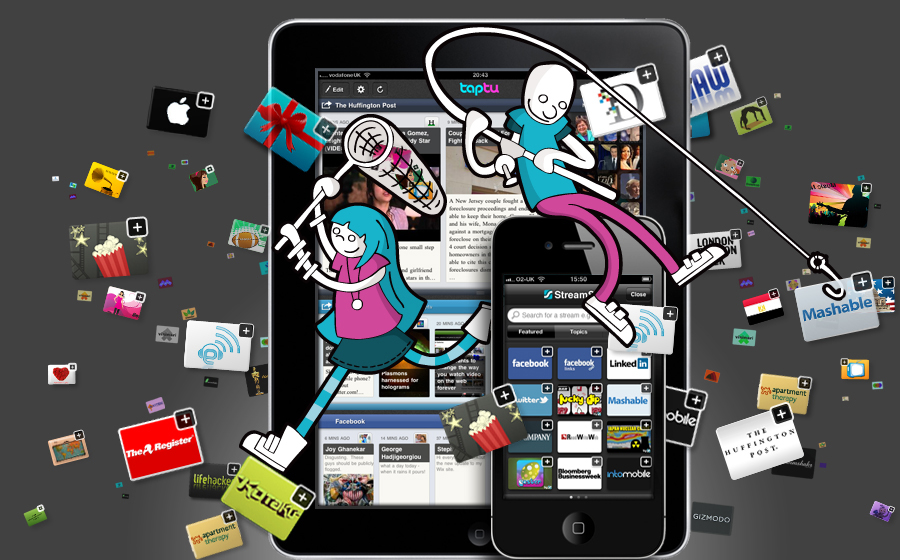
Taptu for iPad – with gorgeous illustration

Taptu Web Fishing illustration

With a spike in visitors to my blog exceeding 1000% of normal activity, the most popular post of all time on this blog is Content – an illustrated history. That obviously excludes the much greater exposure the illustration by Nic Hinton (@karoshikula) and me will have garnered when Mashable and Wired ran with it, and I've since heard that the illustration is being used to teach university students and school kids, and for the purposes of social media training in organisations.

I mentioned in the updates to that post inserted during the ensuing days that Taptu CEO Mitch Lazar had become smitten with the illustration style and had expressed an interest in applying the style at Taptu in future. Well now they've done just that.

Today, the next generation of the popular and free social news reader comes out for iPhone and iPad (it's already rocking and rolling on Android). Taptu calls it the social news DJ – allowing you to mix your favourite news streams. I've posted some of the illustrations used in the app here, but there's nothing quite like checking the app out for yourself and seeing all of them in all their glory... particularly on the larger screen of the iPad. I've also posted a video of the new iPad version in action.

I consider an app like Taptu to be an indispensable tool in the PR professional's armoury. Do you have a favourite social news reader?

Read more

Groupon is bad for business – no April fool

According to BusinessWeek, Groupon could be the fastest growing business of all time – going from zero to rejecting a rumoured six billion dollar offer from Google two years later on the basis it seriously undervalued the company. It's now eyeing up a twenty five billion dollar IPO. Not bad for a discount voucher business.

My sister-in-law recently bought a £300 spa package for £100 via Groupon. Haircut, massage, manicure and pedicure. She's delighted.

"Would you go back to the spa?" I ask. "Definitely" she replies. And then came the qualifier, unprompted: "When they run another Groupon deal."

In other words, the spa in question secured a transaction and eliminated themselves from building a mutually-valued relationship. My sister-in-law will now find it impossible to value the service in her mind at £300, or indeed much more than £100. And with Groupon taking 40-50% commission, it will have been a loss-making transaction at that (following standard accounting principles). Read more

Do Not Track

Today, I’m in Paris. I’m working with the Mozilla Europe team to prepare for the imminent launch of Firefox 4 and Firefox Mobile. And this prompts me to write here on the subject of privacy – a hot topic and one on which your organisation can lead, to your customers’ advantage and yours.

Mozilla is a global, non-profit organisation dedicated to making the Web better. It emphasises principle over profit, and believes that the Web is a shared public resource to be cared for, not a commodity to be sold.

This means that whilst Internet Explorer must justify its existence to Microsoft, Safari to Apple, and Chrome to Google, Firefox is only answerable to you. Many consider Mozilla to be the sole reason we’ve all moved on from the terrible browsing experience Internet Explorer 6 gave over 90% of Web users back in 2003. And now Firefox is the most popular browser in Europe.

Back to privacy. Do you know what information your browser is reporting about your browsing habits? Do you know that some high profile websites add as many as 100 tracking devices to your computer?

Now, lest you think this is some kind of hippy essay, I’m a capitalist. I believe the for-profit motive is the best mechanism we’ve found to date to improve life. But we’ve also seen in recent times that some free markets require a bit of intervention now and then; a spot of regulation. Indeed, a recent Business Week article identified how free-marketers are as fond of regulation as they are more widely reported to dislike it. Read more

Book reviews, or what to give a marketing and PR professional for Christmas

In a fast changing marketplace with fast changing technologies and consumer behaviours we have no option but to work hard keeping ourselves up to speed, week in week out. Time and money constraints rule out keeping abreast simply via course and event attendance, and the only real option is books.

Reading. Lots. Lots of books. Here's a couple to make the Christmas List of any marketing and PR professional.

Real-Time Marketing & PRReal-Time Marketing & PR, by David Meerman Scott

Subtitle: How to instantly engage your market, connect with customers, and create products that grow your business now.

I got my copy of Real-Time Marketing & PR end-October and I just read it yesterday. Mmmm, not exactly a real-time book review then. My only excuse is that I've had to focus on completing my own book (the manuscript is now submitted and it's due out in April with Wiley, the same publisher of David's latest books).

Let's cut to the chase. Should every marketing and PR professional read this book? Yes; even those who consider themselves or are considered to be at the leading edge of this sort of thing. And I make that assertion simply on the basis that David peppers the book with many case studies and examples that will prove useful when attempting to convince the less savvy amongst your colleagues and clients of your point of view. Read more

Intro to Web 3.0 and the Internet of Things at the CIPR Social Summer session

@dewilded summed up one of the key conclusions we reached at the CIPR this evening in his tweet:

Companies thought they were laid bare by Web 2.0, they'll feel positively naked w/out reputation mgt set for RDF & the semantic web #CIPRSM [link]

My role was to act as tour guide and polemicist; to introduce the Semantic Web and the Internet of Things in just 90 minutes; and to leave the session attendees with considerable food for thought.

My slidestack is embedded here FYI, but before I sign off I should thank David Phillips (@DavidGHPhillips / http://leverwealth.blogspot.com) for his most pertinent and enthusiastic contributions to the discussion. He's a man who knows his PR and semantics for sure.

And it appears I may have achieved my objective. As @jonnystark and @Mark_Wyatt put it:

@Sheldrake thanks for the talk. Sat with @dewilded and still talking about it. [link]

@Sheldrake Many thanks for the talk yesterday. Really engaged and informative. Discussion carried on late into the night with @dewilded [link]

[Note: the video links in the presentation don't appear to be working in Firefox at the moment, but they do if you cut and paste the URLs into a browser tab. Odd. Investigating.]

Ethics in PR Measurement

Shonali BurkeI took part in the #measurepr Twitter chat today on ethics in measurement. These chats are organised by Shonali Burke and her blog post "Influence: From BS to Best Practice" set the scene nicely.

At the most fundamental level, we were asking whether some of the techniques being deployed for PR measurement are compatible with the aspiration of public relations professionals to be transparent and authentic, and, more precisely, whether they are compatible with codes of conduct as published by the likes of the CIPR, PRSA and CPRS.

In one of my tweets I suggested a more straight forward test, what one might describe as a layman's test for those of us uneducated in the matters of ethics:

RT @kseniacoffman: Q2: Where do you go for best practices? <-- Ask your mum, siblings, neighbours what's acceptable to them!? #measurepr

At Shonali's invitation, I contributed the three questions posed today... Read more

Friday Roundup: Let’s get emotional… a milestone for PR and marketing

A very interesting thing happened at the end of July.

It affects every single practitioner in the public relations industry, indeed practitioners across all marketing disciplines.

And yet I haven't found one reference to it amongst the PR digerati yet, so I'm going to put that right. Now.

The subtleties of digital

At its core, this digital world is just a set of 1s and 0s that have been applied with increasing sophistication and power. It revolutionised the more numerical professions first, such as accounting and engineering in the seventies, before moving through manufacturing in the eighties and retail in the nineties.

In the noughties, "digital" arrived big style in the lives of marketing and PR professionals simply because it arrived big style in the lives of the stakeholders we look to communicate with, learn from and influence. Read more

My browser history is my own, so back off with your unethical social media metrics

Privacy is a personal thing. Some people want to be as "off grid" as they can get. And then there are those who actually bolt a camcorder to their heads and stream their life 24/7. Irrespective, I believe there are some things that everyone expects to be private by default; even Marc Zuckerberg! And one of these is your browser history... the log that lists every webpage you visit.

It's this list that enables modern browsers to suggest auto-completions for URLs as you enter them in the address bar. It's this list you might visit when you're trying to find that something or other you stumbled across the other day. It's this list that allows your browser to try to render unvisited links one way, underlined blue by default, and previously visited links another way, underlined purple by default (even though individual webpages and associated styling information may actually override these defaults).

My browser history is mine. My wife's browser history is hers. Your browser history is yours.

But whilst the Internet turned 40 last year, the World Wide Web is still a teenager, and that relative immaturity places irresistible temptations in the path of the less ethical. And being able to read your browser history is just one of those.

Has your browser history been "sniffed" recently

You wouldn't know. Read more

The Web of data is a Web of influence

PR and Web 3.0

I'm a fan of Web 3.0. Perhaps obsessed is a more accurate description.

Web 1.0 is the Web of documents. Web 2.0 is the social and user content Web. Web 3.0 is the point at which the Web itself understands that content and social interaction. Some call it the semantic Web, and some call it the Web of data, but regardless of naming conventions, it's going to mess up a hell of a lot of business models, and create some fascinating new business and public-benefit opportunities. And it'll transform reputation management too.

If you think 'atoms of influence' trickle far and wide courtesy of human expressions and understanding with social media acting as loyal conduit, just wait until machines understand these contributions too. Read more