Category: Public Relations (page 9 of 17)

Real-time PR demands rigorous strategic alignment

Real-time PR is a hot topic.

This is nothing to do with fashion, but the unavoidable pressures of modern PR. David Meerman Scott's November 2010 book, "Real-time Marketing and PR" is already a Wall Street Journal bestseller, and with Twitter responses frequently meaningless after an hour's delay, if not minutes, and many conversations requiring a response within the hour or two, awaiting the Monday meeting to debate possible responses is now simply unrealistic.

I presented at Social PR 2011 today on just this topic. The main take home... it isn't easy.

Being the eyes, ears and mouth of an organisation to the drumbeat of the daily news was never easy. Being the eyes, ears and mouth, with heightened sensitivity to influence and be influenced in real-time, requires enhanced levels of strategic diligence, meticulous planning, training, constant attention to detail and rigorous measurement.

Reality is perception.

It’s impossible to fake it.

Real-time PR must, by nature, be authentic.

Real-time PR marks the death of the persuasion / ‘spin’ school.

Long live two-way, symmetric PR fostering mutually beneficial relationships between an organisation and its publics.

The Marketing Century – a compilation of expert insight

The Marketing CenturyYou can now get your hands on The Marketing Century – out this week – a compilation of expert insight across a wide gamut of marketing and PR related topics to celebrate the centenary of the Chartered Institute of Marketing (CIM). The chapter outline here is based on the book's introduction.

I'm delighted to have authored the chapter on digital marketing, and I'm more than happy to answer any questions you may have on reading it.

Buy at Amazon / CIM / The Book Depository / Blackwell's / Waterstone's. And more info at Google Books.

1. Strategic Marketing (Martha Rogers and Don Peppers, Peppers & Rogers Group)

The Marketing Century opens with a clear statement from Don Peppers and Martha Rogers: it is vital that organisations put customers at the heart of what they do, both in the long-term and the short-term. To create value, firms must lift their sights from the typical focus on current profits and instead start seeing customers as the company's long-term resource – looking at each customer in terms of the long-term return they generate. A long-term strategy for marketing – one that focuses on customer equity and not solely on current profits – can provide marketing with the context and objectives needed to maximise the overall value created by each customer. Read more

Meanwhile, a new approach to marketing and PR consultancy

MeanwhileI've teamed up with some very useful chaps to form Meanwhile. We're defining venture marketing. Before I explain that further, I'll elaborate on the main trends that make me think Meanwhile is precisely the right approach at the right time.

In short:

  • Previously distinct disciplines are converging
  • There is a renewed focus on measurement and evaluation of marketing and PR related programmes with boards demanding an unprecedented level of accountability
  • A new framework must emerge placing influence at the heart of business strategy.

Here's how I present the situation in my upcoming book, The Business of Influence (Wiley, April 2011): Read more

Thank you

Just over two years ago I posted about a 'lost cat' poster stapled to trees in my neighbourhood, but a poster with a difference... this was a 'cat found' poster saying thank you to everyone who had helped recover the treasured pet.

Sometimes in business it's too easy to think that the value exchange, where I give you what you want in exchange for what I want, is the be all and end all... the customer has the product or service they were looking for, and we get money (or other currency, like attention).

But every business must strive for a relational rather than transactional customer, moving the focus from the once-off purchase to the lifetime value of the customer and the network of friends and family he / she might bring with them; so emotion comes into it, not just economic arithmetic.

Moreover, perhaps the transaction doesn't complete. I always check my shed to make sure I haven't locked the latest lost cat in there – and whilst I wasn't directly responsible for returning the cat in question above, I was thanked anyway.

Do you say "thank you"? If you do, do you do so in a way that's believable? Authentic? Or in a "have a nice day" automated sort of fashion that communicates no emotion whatsoever and just constitutes pollution?

I have a hypothesis that only those that are passionate about what they do and what they sell can find genuine feeling when conveying their thanks. And I look for this enthusiasm when considering my lifetime patronage of a cafe, bank, web host and, well, everything.

Thank you.

Thank you for your attention, to this Friday Roundup and the previous 160 or so!

Best regards, Philip and the MarCom Professional team. Read more

Social media measurement – easy once you recognise it’s not

The CIPR's social media and measurement group is committed to providing updated guidance to members by the end of January. As the group's chair, I'd better get my skates on. Here's a quick look at the main thrust of our report.

Social media measurement, like business performance management and measurement in general, must measure what's important to your organisation. Sounds simple for a moment doesn't it, except that the view of what's important and what's trivial is pretty much muddied when it comes to marketing and PR measurement and evaluation in my experience.

Take the announcement this week from Sainsbury's, one of the UK's top supermarkets: Read more

The 2011 Plan

Let's talk strategy.

Without thorough strategy, one is resigned to contribute nothing to living up to your organisation's mission and pursuing its vision. Thoroughly resigned. And the turn of the year is an apt time to take the strategic long view.

But let's begin with the shortest view. David Meerman Scott's latest book 'Real-time Marketing and PR' (book review) emphasises that being attuned to the second by second deliberations, assertions and flippancy of the social Web is nothing short of imperative for many organisations. Nevertheless, he also points out that we need our approach to be informed by the organisation's over-arching needs and guided by sound and consistent policy.

The title of a post by Brian Solis this week articulates the challenge succinctly, "failing to plan is planning to fail" and Vanessa DiMauro also calls for proper diligence in her post, "not so fast!"

So how do you know if you're doing OK, or going hand to mouth? Why do too many of the leaders I work with consider they have this licked and yet discover otherwise?

Here's an acid test. Grab a handful of colleagues in your marketing and PR teams this afternoon for fifteen minutes and ask the following four questions: Read more

Book reviews, or what to give a marketing and PR professional for Christmas

In a fast changing marketplace with fast changing technologies and consumer behaviours we have no option but to work hard keeping ourselves up to speed, week in week out. Time and money constraints rule out keeping abreast simply via course and event attendance, and the only real option is books.

Reading. Lots. Lots of books. Here's a couple to make the Christmas List of any marketing and PR professional.

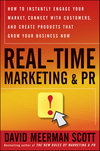
Real-Time Marketing & PRReal-Time Marketing & PR, by David Meerman Scott

Subtitle: How to instantly engage your market, connect with customers, and create products that grow your business now.

I got my copy of Real-Time Marketing & PR end-October and I just read it yesterday. Mmmm, not exactly a real-time book review then. My only excuse is that I've had to focus on completing my own book (the manuscript is now submitted and it's due out in April with Wiley, the same publisher of David's latest books).

Let's cut to the chase. Should every marketing and PR professional read this book? Yes; even those who consider themselves or are considered to be at the leading edge of this sort of thing. And I make that assertion simply on the basis that David peppers the book with many case studies and examples that will prove useful when attempting to convince the less savvy amongst your colleagues and clients of your point of view. Read more

It’s all about curation

If one word has dominated social media in the second half of 2010, for me it's "curation". We have reached a certain maturity in our interaction with media to question our traditional abdication of curation to others.

Until recently, people we don't know decided what we might like to read, listen to and watch. Our only choice, should we disagree with theirs, was to switch channel; change newspaper; retune the radio. And employ technology like personal video recorders to collect what we might want to watch later.

Now a new breed of services is emerging, sometimes referred to as social news aggregators. Read more

Marketing and Communications in the Internetome

I've been out of circulation but had a crazy week before I left, including chairing the launch of 6UK for the promotion of the new Internet Protocol and running the UK's first Internet of Things conference, Internetome. Thanks to the Intellect events team for super event management, and to the sponsors Intel, Qualcomm, Consumer Electronics Association, Meanwhile and 6UK.

Here's my presentation "Marketing and Communications in the Internetome":

The next big big thing: it’s happening now

Marketing and PR as we know it today have been transformed by two massive technological revolutions. The first was the Web, when the Internet became user-friendly, and its subsequent social morphings. The second was the mobile phone and its current zenith, the smartphone. These are the two giants to which most everything else that's changed relates.

The vast majority of marketing and PR strengths and weaknesses, and associated opportunities and threats, stem from the Web and from the smartphone. And yet another giant has emerged to which the vast majority of marketing and PR professionals are mostly blind in my experience: the Internet of Things.

Everything is being connected to the Internet. Cars, dishwashers, air conditioning, power supplies, clothes, animals, bottles of whisky, public transport, medicines, joint replacements, your front door, your training shoes and your bicycle. It is happening right now.

If you're an innovator on the lifecycle / adoption curvy thing, then you were thinking about the Web in 1995, about mobile in 1998, and smartphones in 2005. You started scoping the Internet of Things in 2008.

Now it's the end of 2010, it's the time for the early majority to embrace the Internet of Things, and that's you if you want more of that opportunity to come your way than the competition's. Join me at Internetome, the Internet of Things Conference, in London, November 10th. Sponsors include Intel, Qualcomm and the Consumer Electronics Association, and my own company.

And as the Internet of Things impacts all aspects of business not just marketing and PR, I'd urge you to get on the front foot and let the rest of your organisation / your clients know. Today.

Hope to see you on the 10th :-)

Best regards, Philip and the MarCom Professional team. Read more