Category: Public Relations (page 8 of 17)

The ROI of Public Relations – Friday Roundup

The AMEC European Summit of 2010 is famous for killing anyone's lingering hopes that advertising value equivalence (AVE) represents any kind of measure of the value of PR. As I like to say, AVE is a specious sum based on false assumptions using an unfounded multiplier, only addressing a fraction of the PR domain. <sarcasm>Apart from that, it works just fine!</sarcasm>

This summer, the European Summit delegates set AMEC's top priority as determining an approach to measuring the return on investment (ROI) of public relations. Sounds a most admirable ambition, but should this be interpretted in the way I think it might, I fear we may be at risk of having dethroned one false idol only to pursue another.

Why? Because investment in public relations is investment in strategically important intangible assets, and such investments cannot be designed, executed or analysed in isolation. As Drs Kaplan and Norton put it in their 2004 book Strategy Maps:

"Economic justification of these strategic investments can be performed, but not in traditional ways. The common approach is on a stand-alone basis: ‘Show the ROI of the new IT application’, or ‘Demonstrate the payback from the HR training program.’ … But each investment or initiative is only one ingredient in the bigger recipe. Each is necessary, but not sufficient. Economic justification is determined by evaluating the return from the entire portfolio of investments in intangible assets…"

What does this mean? Well consider the hypothetical instance of two organisations designing, executing and analysing exactly the same public relations strategy delivering precisely the same results for the same investment. Read more
Not PR – Friday Roundup

"CELEBRITIES, blue-chip companies and tourist attractions are using a new breed of PR company to hide their secrets and damaging press stories in Google search results. Online 'reputation management' agencies promise to suppress negative search results by driving them down the rankings."

So opens an article in The Times on Wednesday this week. (I can't provide the link to The Times as I'm not a subscriber to its paywall, but it's syndicated here, sans paywall, to sister publication The Australian.)

On reading the article, part of me recognised this sort of capability at the same time another part of me felt very uncomfortable with it being associated directly with PR. And then I winced some more...

"[These agencies] typically use thousands of social networking profiles - set up using false names and operated using computer software to simulate the behaviour of a real person - to talk about and link to more positive results, pushing them above the negative stories."

This is NOT public relations. This is not two-way communication aspiring to foster mutual understanding between an organisation and its publics. Such activities clearly breach the CIPR's code of conduct, specifically its references to integrity and honesty. A PR professional never knowingly misleads about the nature of their representation. Read more

Truth be told – Friday Roundup

According to the renowned Excellence study, public relations is a management function that focuses on two-way communication and fostering of mutually beneficial relationships between an organisation and its publics. One might argue that one can't aim to please (benefit) everyone, so it might be more appropriate to emphasise mutual understanding rather than mutual benefit, as indeed the CIPR's current definition of PR does.

Despite the common association of PR with spin (spin a yarn, make up a story), the PR professional focuses on symmetrical communication based on truths and understanding. Indeed, I like to say that whilst 'perception is reality' may have been a dominant axiom for 20th Century practice, the 21st Century professional acknowledges that changes to media, communications technology and societal expectations now renders 'reality is perception' more appropriate.

But what is truth? Read more

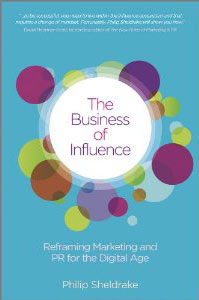
My book, The Business of Influence, is out today

Today's the day!

It's ready for delivery in the UK today, and pre-order in other parts of the world. For those of you tweeting about availability in the US, currently listed as mid-June by some bookstores, Wiley tells me it should actually be with you mid-May. Thank you for your interest and patience.

What's it about?

The Business of Influence: Reframing Marketing and PR for the Digital AgeThe Business of Influence is a rethink.

It's about improving the capabilities of organisations to design and attend to the way in which all aspects of its operations influence stakeholders, about making sure stakeholders influence it, systematically, and about how well competitors are attempting the same. It focuses on influence as the common denominator of marketing and public relations and related activities such as customer service, sales, product development and HR, and therefore the basis for redesigning these and interconnecting them.

The book introduces the Influence Scorecard, named in homage to the dominant framework for business performance management, the Balanced Scorecard. The Influence Scorecard then is a subset or view of the Balanced Scorecard containing all the influence-related key performance indicators (KPIs) stripped of functional silo, and it may extend beyond the Balanced Scorecard should a greater operational granularity of metrics be demanded by the influence strategy.

The Influence Scorecard is a new framework for the 21st-century designed to help organisations focus on what matters rather than continue to carry the baggage and inefficiencies that come part and parcel of the typical 20th-century marketing and PR structure and approach. It's a reframing in the context of 21st-century media and disintermediation, 21st-century technology, and 21st-century articulation of and appreciation for business strategy. Read more

Social analytics on CIPR TV – with Connie Bensen, Emily Dent and Marcel LeBrun

Regular readers know that social analytics is a subject close to my heart. And would you believe it, my ebook on the matter, The Social Web Analytics eBook 2008, still gets downloaded a thousand times a month. I also made sure to include a section on social analytics in my book of course (out this month in the UK and shortly in the US), listing twelve primary characteristics of the services to assist in your organisation's tool selection and procurement.

Well yesterday's CIPR TV was on the topic of social analytics, and Russell and I were delighted to have Alterian's Connie Bensen and NMIncite's Emily Dent join us on the sofa. We also managed to interleave a three minute interview I grabbed with Radian6 CEO Marcel LeBrun at last week's Radian6 Social2011 conference.

Check it out:

Radian6 and the Insights Platform – getting semantic

Radian6 Social2011 conferenceI'm in Boston this week for the Radian6 Social 2011 Conference. (Disclosure: Radian6 is paying my expenses to be here.) So far I've enjoyed talking with Radian6 CMO David Alston, OpenAmplify CEO Mark Redgrave, Edelman's David Armano, Dell's Head of Interactive Marketing Adam Brown, Klout Head of Platform Matthew Thomson, Marshall Sponder and Nathan Gilliatt.

Radian6 CEO Marcel LeBrun has kicked off the event this morning by launching the new Insights Platform, and I appreciate why Marcel is so enthusiastic about it.

Here's how Radian6 describes it:

Insights are answers. Insights give meaning to unstructured volumes of content based your needs and integrated into our current dashboard offering. Current partners include Klout, OpenAmplify and OpenCalais. The insights that each of these partners offer (like age range, location, influencer score, textual analysis) are added as drill down options on the Dashboard widgets, so you are able to take your Radian6 topic profile mentions and overlay the insight partner data all in one place. No exporting River of News and doing comparative analysis in Excel to these providers data from your separate account, now it’s all been brought together for you.

How does it work? Well Radian6 has leaned heavily on the three partners, with both OpenAmplify and OpenCalais having deep expertise in semantic technologies. This is the tech that helps interpret, understand and process the meaning of content. Serious stuff. Read more

The CIPR Conversation – a 1st

The Conversation

The CIPR has just announced that it will be launching The Conversation this coming Monday, during its social media conference. The Conversation provides the facility to aggregate the best PR related blogs from members and non-members, in the UK and further afield. And it goes live under a full head of steam because The Conversation is the new face of MarCom Professional, the network I've been running for the past four years. Here's what the CIPR has to say:

The Chartered Institute of Public Relations (CIPR) is launching ‘The Conversation’ at its social media conference, 11 April. The Conversation is your one-stop shop for great blog posts by practitioners, consultancies, academia and students, from the UK and further afield. Syndicating your personal or company blog couldn't be easier, allowing the wider PR community to find your content, find your personal, business and consultancy profiles, and respond to your news and points of view. Everyone is welcome to register themselves and their organisation.

In the spirit of The Conversation, the CIPR has invited some of the UK's keenest PR bloggers to break this news.

There will be no need to ‘make friends’ all over again on The Conversation. Simply give your existing social networks permission to allow us to take a look at your network, your social graph as some call it, and we'll make sure those relationships are established immediately on The Conversation (ie you won't need to share your passwords with us). Hey presto, instant social glue.

The Conversation promises to be an exciting addition to the CIPR's website, at least it will be with your input. It won't match Facebook for functionality or LinkedIn for seeing who's connected to whom, but it will be the first such attempt by a professional body to our knowledge. We hope you'll jump in, and work with us as we iron out the inevitable glitch or two.

Following the successes of the CIPR social media panel – CIPR TV, 'Social Summer' events in 2010 and 2011, social media measurement guidance and input to ASA regulation – it's apt that The Conversation will be launched at the CIPR social media conference. We hope to see you there.


Nice blog post from MarCom Professional Friday Roundup author Andrew Bruce Smith too.

Money

Let's talk about money.

Michael Porter describes strategy as defining and attending to those activities at which an organisation must excel in order to create a sustainable difference in the marketplace, and thereby create sustained value for its shareholders (or sustainable value in the case of non-profits).

Once you've articulated why your organisation exists (the mission), and what you want it to be (the vision), the strategy describes the what, who, how, when and where needed to pursue the vision, and specifically how these differ from the competition. How these help beat your competition.

However, as hard as strategy formulation is, the really hard part is putting it into action. The Balanced Scorecard Institute finds that 70% of organisations with a strategy simply fail to execute it. And this becomes the more obvious the further away from the sale / the product / the service you get; the more you get into the intangible assets pivotal to your success.

Marketing and PR are intangible assets. They are intangible investments. We all know that the right mix of the panoply of marketing and PR activities is essential to organisational success – to the successful definition of organisational strategy and its execution – but too often we're not quite sure how so. This is most apparent when, particularly in harder times, marketing and PR are considered cost centres first and foremost, and cost centres that can be cut. Read more

Influence in the age of the social web – keynote to EUPRERA

It's a beautiful sunny Spring day here at the EUPRERA Spring Symposium in Lisbon. It's my first time at this gathering of the European Public Relations Education and Research Association – the forum for innovative PR research and education – and I'm delighted to have been invited to deliver the keynote.

Thanks to Philip Young and David Phillips for the invitation. Here's the slidestack. I was a bit surprised to get a slide count of 77, but 16 of the slides present the infographic 'Content – An illustrated history', which is easy to breeze through :-)

In conversation about the BP Deepwater crisis with Neil Chapman

Neil recently left BP after 14 years where his most recent role was in the unified command centre in the US, set up to respond to the Deepwater Horizon explosion and oil spill in the Gulf of Mexico. Neil has more than 25 years' managing public affairs issues and crises that have grabbed the headlines in different parts of the world, helping scores of executives to help them communicate more effectively in support of their businesses.

Neil now runs Alpha Voice Communications.

I'm increasingly pleased with the live CIPR TV format and the questions submitted via the streaming video player, Twitter and Facebook. Without such participation we wouldn't have thought to ask Neil about the internal communications aspects of the BP crisis, for example, although the question about Neil's regard for the controversial (ex-)CEO, Tony Hayward, was to be expected!

Neil's responses are compulsory watching for every PR practitioner imho.