Category: Public Relations (page 3 of 17)

An introduction to Web 3.0 for Social Data Week

Next week is Social Media Week. That's well known. What's less well known is that this is Social Data Week, and this facet of social underpins a lot of the stuff on next week's agenda. Nevertheless, many people with social in their job description, from public relations to marketing to 'digital', are not yet fluent in the data foundations.

One aspect of social data that particularly excites me is the Semantic Web, often referred to as Web 3.0. According to Sir Tim Berners-Lee, the inventor of the World Wide Web, Web 3.0 describes the web as a universal medium for the exchange of data, information and knowledge. It's an awesome vision that's playing out right now.
BrandwatchBrandwatch is one company that understands social data better than most.

I've known Giles Palmer, the founder and CEO of Brandwatch, since I interviewed him for one of the first ebooks on social analytics all the way back in 2008. Brandwatch shares my enthusiasm for the Semantic Web and related technologies, so I'm delighted that the company has sponsored the production of this stack.

If you're procuring or reviewing your current choice of social listening, analytics and intelligence service, then check them out.
Share This Too

Share This TooEver since we started the CIPR Social Media Panel we've been a pro-active bunch. I haven't got the stats to prove it, but I'd bet the panel is the most active CIPR group. We launched the successful "Social Summer" sessions, developed Wikipedia guidance (subsequently adopted by equivalent organisations in Canada, Australia and South Africa), created CIPR TV, published the CIPR Social Media Guidance, updated the CIPR's own social policy, published the CIPR Guide to Social Media Monitoring, and much more.

Social Summer was the genesis for the 2012 book, Share This, currently listed by Amazon amongst its UK Top 50 books in the PR category, and US Top 100. (Note to Amazon: PR is not a subsidiary discipline of Marketing, so the PR category should not be subsidiary to the Sales & Marketing category.)

Having had the distinct pain of editing Share This, Stephen Waddington demonstrated his masochistic side by proposing a follow up this year. Fortunately, Rob Brown volunteered as co-editor, and tonight is the launch party at the British Library of Share This Too.

Here's the blurb from the CIPR:

"The book is split into 33 chapters over eight topic areas, covering the future of public relations, audiences and online habits, conversations, new channels, new connections, professional practice, business change and opportunities for the public relations industry, and future-proofing the public relations industry.

"Each chapter has been contributed by one of the foremost experts in the given subject area, and the foreword for the book is from Brian Solis, digital analyst and author of What’s the Future of Business (WTF).

"Share This Too has been edited by CIPR Board Members Rob Brown and Stephen Waddington with contributions from Dominic BurchRobin WilsonGed CarrollKate MatlockAdam ParkerMark PackSharon O’DeaPaul FabrettiMichael LitmanRussell GoldsmithStephen DaviesScott SeabornDan TyteMatt ApplebyKevin RuckHanna BashaChris NortonBecky McMichaelRachel MillerStuart BruceRichard BaileyJane WilsonJulio RomoJed HallamKaty HowellGemma GriffithsPhilip SheldrakeRichard Bagnall Drew BenvieAndrew Smith and Simon Collister."

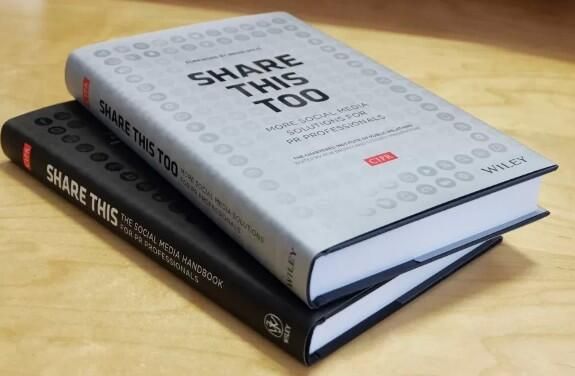
Share This, and Share This Too. Photo by Stephen Waddington.

What, exactly, is social business?

I'm kicking off #SCRM13 in London this morning. SCRM stands for social customer relationship management, and my role today is to get some energy into the room and, hopefully, encourage delegates to look up from simply slapping "social" onto business as normal.

Unfortunately, that's precisely what many have been charged with doing. Those with appropriate powers of persuasion will effect organizational change I'm sure, but more to the point I feel that more chief executives need to attend Luke's conferences, a sentiment I'm sure he'd endorse.

I'll finish this short post with a quote from one of the characters in Attenzi - a social business story, chapter 60 (they're short chapters!)

"Don’t you want CRM to help you and the customer mutually, allowing you both to manage the relationship? Surely the value of your understanding how influence goes around comes around is enhanced when those you interact with have similar understanding. Or would you rather propagate the status quo – CRM as a construct to manage the customer? Who do you think best knows the customer in the round today anyway – you or him?"

How dare they!

[Written originally for the CIPR Friday Roundup.]

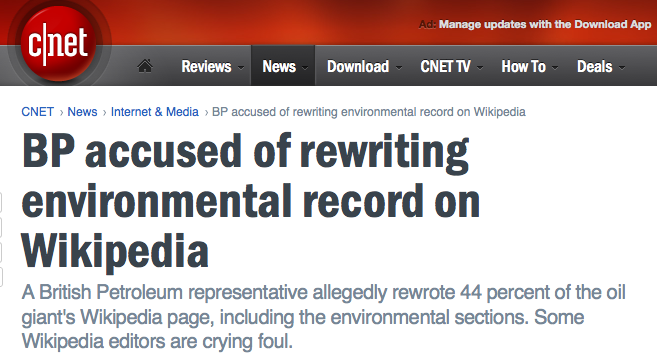
You should not make edits to a Wikipedia entry when you have a conflict of interest, as any PR practitioner does in relation to their employer or client. Simple.

CNET screenshot BP Wikipedia

This Wikipedia rule is reflected precisely in the CIPR's Wikipedia guidance, published by the social media panel last summer and supported by PR bodies in Canada, Australia and South Africa. (Although not yet in the US.) Read more

‘Masterclass’ at Bournemouth University

Professor Tom Watson (@tomwatson1709, @historyofpr) invited me to deliver a 'masterclass' lecture at Bournemouth University on Friday. (When asked about PR higher education in the UK, most people would mention Bournemouth and Leeds Metropolitan.)

Student elections were at fever pitch, and there was a real energy about campus. The students at The Media School were on top form – in fact, I usually only get the calibre of questions they threw at me days or weeks after someone has digested my book or a presentation. So thanks to everyone who attended and participated.

HT to @lauramanninen, @kbadders, @hannaherowley, @edinjel, @JessicaNorthPR, @lottsGC, @FleurieFM, @morellopr, @BenjaminDeacon.

Here's the stack.

Dell Social Media Predictions 2013

I enjoy Full Gesture Communication™ in Unaugmented Reality™ (#fauxtrademarks). As amazing as social media is becoming, it's still no full substitute for eye-to-eye interaction. I met the co-founding CTO of Yammer this week, Adam Pisoni, and our conversation came to life immediately in a way that I don't believe would be as easy to kindle pixel-to-pixel.

Here's an interesting question I think. Can you distinguish in your mind the kinds of online relationships you have with people you see physically from time to time from those you've yet to meet? I believe you probably can, and probably do.

This topic just cropped up again for me this morning. It may be a sixth of the way through 2013, but Dell has just published a little slidestack quoting some pundits, including yours truly, on some development aspects of social media this year. Geoff Livingston is quoted as saying: "I really believe in events. Online becomes much more substantial when someone meets you face to face. Try to create ways to meet your stakeholders in person so you can cultivate a deeper substantial relationship."

Do you think digital technologies can help crack this nut? How? When?

Social Media Predictions for 2013 from Dell Social Media

GREAT (PR)ODUCT

I have asked six people with senior positions in techie professions who they thought "does great PR" in the tech sector. Now these individuals are not in marketing and PR functions, so you'll forgive my casual turn of phrase I hope.

Apple iPad mini – GREAT (PR)ODUCTYou might know I detest the idea that you might "PR something", as if PR is as tactical and atomic as picking up the phone or putting a release on a wire, but I deliberately didn't wish to infect them with my view of public relations excellence. I wanted to hear what they'd say unprompted, unguided.

Each proffered two or three companies. Samsung and IBM were mentioned twice. Google thrice. But out front with four mentions was Apple.

Now anyone who follows the world's first or second largest publicly traded corporation in the world by market capitalization (it swaps places regularly with Exxon Mobil) will know that they're actually quite a secretive bunch. Steve Jobs infected the company with the idea that it knows what's best for the customer, and any idea that it should work with the rest of us in defining future products and services appears plain counter-cultural.

If you, like me, define public relations as pursuing mutual understanding to build goodwill, the PR function at Apple appears quite asymmetric. As and when it suits its agenda, they'll tell you. Otherwise get back in line. End of. I always feel a reluctance on Apple's part to discuss its contractors' labour practices, its own environmental and business practices, and the occasional product mess up. Read more

A Measure Of Influence – IABC Communication World magazine

Communication World, Jan/Feb 2013 coverJessica Burnette-Lemon is Senior Editor of Communication World, the IABC's member magazine. I had the pleasure of talking with Jessica on the topical and some might say controversial topic of influence (in the context of marketing and PR of course).

The resultant article appears in the current issue of the magazine, but because it's a publication for members' eyes only, I can't add a link here.

Fortunately, Jessica has given me permission to reproduce the article right here, "A Measure Of Influence" (PDF). I hope you find it interesting.

The article pulls out one quote up front. At the risk of stating the obvious:

The best way to exert useful influence remains to deliver great products and services so that your customers evangelize your brand to friends and family, and to be a well-run organization so that your employees and partners evangelize working with you.


Do you believe it?

[Originally written for the CIPR Friday Roundup.]

The 2007 report from the Arthur W. Page Society, The Authentic Enterprise, identified four new leadership priorities and skills demanded of the Chief Communications Officer:

  • Leadership in defining and instilling company values
  • Leadership in building and managing multi-stakeholder relationships
  • Leadership in enabling the enterprise with ‘new media’ skills and tools; and
  • Leadership in building and managing trust, in all its dimensions.

Building Belief - Arthur W Page SocietyThe report marked the beginning of a rethink at the Society that culminated last year in Building Belief: A New Model.

I'm a fan of the Society and made sure to reference the four leadership priorities in my book The Business of Influence. I'm slightly obsessed with defining the role, skills and traits of CCOs, if only because this matter appears to be mission critical when it comes to making an organisation fit for the 21st Century. If you share this interest, do take time to familiarise yourself with Building Belief if you haven't already done so.

As we approach the first anniversary of Building Belief, I'm very interested in gathering reports of the model in practice, particularly as it complements aspects of the Six Influence Flows model. If you have a story to tell in this regard, do please drop me a line.

Arthur W. Page Society Chairman, Jon Iwata, on Building Belief