Category: Communities/Social Networks (page 5 of 10)

The 1st CIPR TV show

CIPR TV is underway!

I co-presented the first show this afternoon at 5pm with Stephen Waddington (@wadds) and, despite the novice presenters, two aspects worked really well. First up, Paul Mylrea was a fantastic guest. The BBC's Head of Press and Media Communications, and the CIPR's 2011 President, Paul was never stuck for an interesting and articulate response to a wide range of questions spanning public sector PR, reputation washing, graduate recruitment and internships, diversity, the CIPR's response to the ASA's misguided stance towards social media, and his plans for the CIPR next year.

And our second advantage was simply working with the highly professional markettiers4dc team. Thanks guys for making us feel like we were in safe hands!

Bookmark www.cipr.tv and track #ciprtv too.

And join us again at 5pm on the 29th when we'll be quizzing Mark Borkowski on all aspects of publicity, how his work best integrates into the marketing mix, and his comments on the latest news, roaring campaign successes and, perhaps, analysis of when things don't quite go to plan. But I'm most looking forward to grilling Mark on the repositioning of his firm:

Borkowski has evolved into something new for the digital age - an agency dealing with brand truths and the empowerment of the individual, changing Public Relations into Public Conversations.

The Friday Roundup: The ASA’s misstep

Some things aren't quite as simple as first they seem. And when this is the case, it's good practice to consult widely. And on this count, the UK Advertising Standards Authority (ASA) has failed.

On 1st September, the ASA announced: "Landmark agreement extends ASA's digital remit". The scope of its Committee of Advertising Practice, the body responsible for the CAP Code governing UK advertising, will extend to "apply in full to marketing communications online, including the rules relating to misleading advertising, social responsibility and the protection of children. The remit will apply to all sectors and all businesses and organisations regardless of size."

Now who could possibly argue with that? Read more

Intro to Web 3.0 and the Internet of Things at the CIPR Social Summer session

@dewilded summed up one of the key conclusions we reached at the CIPR this evening in his tweet:

Companies thought they were laid bare by Web 2.0, they'll feel positively naked w/out reputation mgt set for RDF & the semantic web #CIPRSM [link]

My role was to act as tour guide and polemicist; to introduce the Semantic Web and the Internet of Things in just 90 minutes; and to leave the session attendees with considerable food for thought.

My slidestack is embedded here FYI, but before I sign off I should thank David Phillips (@DavidGHPhillips / http://leverwealth.blogspot.com) for his most pertinent and enthusiastic contributions to the discussion. He's a man who knows his PR and semantics for sure.

And it appears I may have achieved my objective. As @jonnystark and @Mark_Wyatt put it:

@Sheldrake thanks for the talk. Sat with @dewilded and still talking about it. [link]

@Sheldrake Many thanks for the talk yesterday. Really engaged and informative. Discussion carried on late into the night with @dewilded [link]

[Note: the video links in the presentation don't appear to be working in Firefox at the moment, but they do if you cut and paste the URLs into a browser tab. Odd. Investigating.]

Hosting CIPR TV… live at five!

The last time I was on TV it was the BBC's Working Lunch, March 2002. I was running Europe's first email money service at the time (before PayPal was available in these parts) and our servers were struggling quite a lot under the weight of our success on eBay UK. Facing up to a firm line of questioning, I was able to reassure Working Lunch viewers that any money they had stored with us was safe and sound.

Fast forward eight years and the definition of TV has changed somewhat. Indeed YouTube wasn't even launched until 2005, before going on to be the fastest growing website ever. By 2007, the capacity consumed by YouTube exceeded that of the entire Internet in 2000. In May this year, over 24 hours worth of video was uploaded to YouTube for every single minute of the month!

And now we have . Read more

Friday Roundup: I’d like to quote you

I'd like to quote you.

Without doubt, the marketing and PR professions are in revolutionary flux right now. I reckon that if we didn't have these disciplines to date but just realised here and now that we actually wanted to influence what people think and do, and ensure we're influenced straight back, that we'd design things very much differently to the status quo we've inherited.

I'm delighted that Wiley has invited me to write a book on just this topic. It's going to focus on the much needed transformation of marketing and PR strategies, and the related disciplines in the influence mix, for the current and future digital age.

The book explains what’s happened, what’s happening and what’s coming up. It points to the changes of direction organisations and individual practitioners must pursue to remain relevant.

And in the spirit of a marketer honing a product’s positioning, I’ll tell you what this book is not. This book is not a social media ‘how to’. Rather, it's about your organisation, your profession and your career. As with all changes to the competitive landscape, the earliest adapters will secure competitive advantage for their organisation and personal careers, whilst the laggards will suffer competitive disadvantage. And quickly.

I'd like to quote you. Please do get in touch if you'd like to share your viewpoint and experiences... the book will only be improved by your contributions. Seriously, do it!

And if you're interested in the bit about what's coming up, I'm running a session this coming Thursday in London at the CIPR on the Web 3.0 and the Internet of Things if you'd like to join us.

Best regards, Philip and the MarCom Professional team. Read more

The Web of data is a Web of influence

PR and Web 3.0

I'm a fan of Web 3.0. Perhaps obsessed is a more accurate description.

Web 1.0 is the Web of documents. Web 2.0 is the social and user content Web. Web 3.0 is the point at which the Web itself understands that content and social interaction. Some call it the semantic Web, and some call it the Web of data, but regardless of naming conventions, it's going to mess up a hell of a lot of business models, and create some fascinating new business and public-benefit opportunities. And it'll transform reputation management too.

If you think 'atoms of influence' trickle far and wide courtesy of human expressions and understanding with social media acting as loyal conduit, just wait until machines understand these contributions too. Read more

Friday Roundup – Twitter, the Human Seismograph

Ever considered Twitter in terms of it being a "Human Seismograph"?

Brian Solis won't mind me pointing out that he likes to invent memorable turns of phrase. It's a common trait amongst communicators working on any cutting edge because sometimes existing phraseology doesn't quite do justice to the point being made. So here we are, discussing human seismography.

And two posts this week portray the seismograpic needle waggling wildly.

Firstly, Brian's post "Oil Spill Report: BP and White House Sentiment Spills onto Twitter" reviews the sentiment towards BP as expressed on Twitter. Perhaps the most interesting aspect of this detailed analysis is the deleterious knock-on impact the disaster has had on sentiment towards President Obama. Of course, correlations offer no evidence of cause-and-effect unless individual exclamations of feeling explicitly express such a connection, and this is something social web analytics can examine. Read more

An interview with Seth Godin – PR not publicity

Seth Godin

Seth Godin - www.flickr.com/photos/joi/4035933108/

Seth Godin is a perceptive individual. He spots things the rest of us are too busy to see, and then lets us know about them in an easily-digestible format. Sounds like a cracking formula for a best-selling author if you ask me... and of course he is.

With a dozen titles to his name, including Tribes, Meatball Sundae, perhaps most famously Permission Marketing, and most recently Linchpin, interviewing Seth was always going to be both entertaining and insightful.

Interview with Seth Godin

Read more

TweetDeck’s Iain Dodsworth at CIPR Social Summer

TweetDeck

Last night the CIPR Social Summer series hosted a session on all things TweetDeck. If you haven't tried TweetDeck, try it now. It's free!

According to Twitstat.com today, after simply tweeting at twitter.com, Tweetdeck is the most popular Twitter client globally. Here's the stats I just grabbed from Twitstat:

Rank Client % of users Tweets/user
1 (1) web 16.80 % 2.90
2 (2) TweetDeck 9.50 % 3.17
3 (6) twitterfeed 5.90 % 5.58
4 (3) foursquare 5.85 % 1.49
5 (4) Twitter for iPhone 5.85 % 2.38
6 (5) HootSuite 5.39 % 2.68
7 (8) Echofon 3.22 % 3.25
8 (25) API 2.76 % 6.66
9 (7) Tweetie for Mac 2.55 % 2.38
10 (9) Seesmic 2.16 % 3.02

But TweetDeck is more than a nice way to shepherd incoming tweets and craft your own. TweetDeck is rapidly becoming the most powerful way to manage your social networking without ever having to log onto each and every social network yourself. It aggregates Twitter, Facebook, LinkedIn, Google Buzz and Foursquare, and it even lets you watch YouTube videos brought to your attention by your social network in situ.

So I was particularly delighted when TweetDeck MD Iain Dodsworth (@iaindodsworth) accepted our invitation to join us for one of our sessions to share his insights and answer our questions. Read more

An interview with Brian Solis

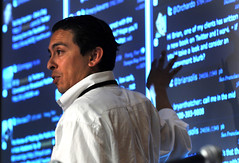
Brian Solis at Affiliate Summit East 2009
Image by affiliatesummit via Flickr

I interviewed Brian Solis for the CIPR's website recently. Brian is one of the most prominent thought leaders and published authors in new media. A digital analyst, sociologist and futurist, Solis helps practitioners get to grips with the effects of emerging media on marketing, communications and publishing.

His perspectives are well worth a listen:

Brian Solis interview 20th June 2010

One quote I'd pick out is this:

PR used to be right there at the top, but we slipped into publicity and media relations and spin, and forgot the opportunity to steer and shape perception, just such an opportunity afforded by participation and engagement in social media.

Brian's conclusion on this issue are optimistic however. When I asked him if this was a renaissance moment for PR, he basically claimed it to be a renaissance moment for every discipline in the "socialisation" (or is that with a "z"?) of business.