Archives (page 12 of 43)

Share This Too

Share This TooEver since we started the CIPR Social Media Panel we've been a pro-active bunch. I haven't got the stats to prove it, but I'd bet the panel is the most active CIPR group. We launched the successful "Social Summer" sessions, developed Wikipedia guidance (subsequently adopted by equivalent organisations in Canada, Australia and South Africa), created CIPR TV, published the CIPR Social Media Guidance, updated the CIPR's own social policy, published the CIPR Guide to Social Media Monitoring, and much more.

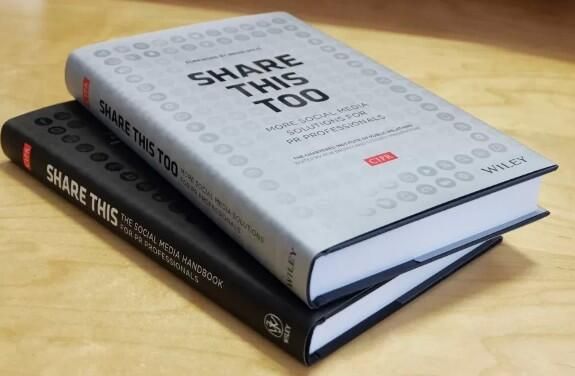
Social Summer was the genesis for the 2012 book, Share This, currently listed by Amazon amongst its UK Top 50 books in the PR category, and US Top 100. (Note to Amazon: PR is not a subsidiary discipline of Marketing, so the PR category should not be subsidiary to the Sales & Marketing category.)

Having had the distinct pain of editing Share This, Stephen Waddington demonstrated his masochistic side by proposing a follow up this year. Fortunately, Rob Brown volunteered as co-editor, and tonight is the launch party at the British Library of Share This Too.

Here's the blurb from the CIPR:

"The book is split into 33 chapters over eight topic areas, covering the future of public relations, audiences and online habits, conversations, new channels, new connections, professional practice, business change and opportunities for the public relations industry, and future-proofing the public relations industry.

"Each chapter has been contributed by one of the foremost experts in the given subject area, and the foreword for the book is from Brian Solis, digital analyst and author of What’s the Future of Business (WTF).

"Share This Too has been edited by CIPR Board Members Rob Brown and Stephen Waddington with contributions from Dominic BurchRobin WilsonGed CarrollKate MatlockAdam ParkerMark PackSharon O’DeaPaul FabrettiMichael LitmanRussell GoldsmithStephen DaviesScott SeabornDan TyteMatt ApplebyKevin RuckHanna BashaChris NortonBecky McMichaelRachel MillerStuart BruceRichard BaileyJane WilsonJulio RomoJed HallamKaty HowellGemma GriffithsPhilip SheldrakeRichard Bagnall Drew BenvieAndrew Smith and Simon Collister."

Share This, and Share This Too. Photo by Stephen Waddington.

What, exactly, is social business?

I'm kicking off #SCRM13 in London this morning. SCRM stands for social customer relationship management, and my role today is to get some energy into the room and, hopefully, encourage delegates to look up from simply slapping "social" onto business as normal.

Unfortunately, that's precisely what many have been charged with doing. Those with appropriate powers of persuasion will effect organizational change I'm sure, but more to the point I feel that more chief executives need to attend Luke's conferences, a sentiment I'm sure he'd endorse.

I'll finish this short post with a quote from one of the characters in Attenzi - a social business story, chapter 60 (they're short chapters!)

"Don’t you want CRM to help you and the customer mutually, allowing you both to manage the relationship? Surely the value of your understanding how influence goes around comes around is enhanced when those you interact with have similar understanding. Or would you rather propagate the status quo – CRM as a construct to manage the customer? Who do you think best knows the customer in the round today anyway – you or him?"

Measuring Public Relations – a presentation

I was invited to kick off the CharityComms "Made to Measure Communications" event today. Being a fan of measurement, or business performance management more widely, I'm always excited about meeting new people and sharing ideas and insights, but given that many find the topic a little dry to say the least, I'm grateful for any and all interaction and enthusiasm event attendees might muster. And today's audience didn't let me down, so thank you for that.

As promised, here's the stack.

Social media measurement, after Madrid

What, exactly, is the value of social? This was the question I sought to help answer in my slidestack ahead of the AMEC European Summit in Madrid earlier this month. And it was the overarching question that informed much of the three days of debate, discussion and deliberation.

This post is about two related developments – the latest from "The Conclave" (aka the #SMMStandards Coalition), and "A New Framework for Social Media Metrics and Measurement".

Measurement standards

"Perhaps the most important Social Media launch of the year" is how Katie Delahaye Paine portrays it. This is so-Katie that I can actually hear her saying it right now (as she might hear me cry "the most exciting development in PR since the Cluetrain"!)

Katie refers to a suite of social media measurement standards that represents the work of a collection of organisations (including AMEC, a full list is appended here) informally referred to as The Conclave. Following 18 months of long conference-calls, meetings, slidestacks and email threads, we have posted standards for: Read more

A presentation to the Open Mobile Alliance conference on big data

According to its website, the Open Mobile Alliance "was formed in June 2002 by the world’s leading mobile operators, device and network suppliers, information technology companies and content and service providers. OMA delivers open specifications for creating interoperable services that work across all geographical boundaries, on any bearer network."

The OMA met today in Dublin to discuss aspects of big data, and I was invited to present on personal data, social media and social business.

I've met some great people today and we've covered some pretty geeky things between us, but the experience has left me with a renewed appreciation of the differences between 'net' and 'telco' people. For example, this was the first conference I've been to in many years that didn't have an agreed hashtag, or many people tweeting come to that. And mine was the only stack not to claim copyright, rather my normal Creative Common licensing. Trivial examples maybe, but indicative nonetheless of a different (but no less apposite) mindset.

I've tried my best to persuade a standards-setting collective to think harder about when to intervene and about the longer-term ramifications they might have on all the good stuff the Internet, the open Web and related technologies can do and are doing for humanity and our custodianship of the planet. That's not to undermine the value of standards, far from it, but as the saying goes, everything can start to look like a nail when you have a hammer.

I asked them to think about "humans" or "people" rather than "consumers" and "users", and about putting the facility for all humans to realise their full potential ahead of shareholders. That's not counter-capitalist. I put shareholders' best interests first by putting them second. You can find out more about this perspective in my recent ebook, Attenzi - a social business story.

The meaning of social business

[Also published on Microsoft's #bizremagined website.]

I’m fascinated by innovations in the language of innovation. Is it the inclinations of the innovator or the characteristics of the innovation that suggests new words and phrases? When and why is existing lexicon deemed inadequate? Why do we embrace some expressions yet others wither and die?

A quick browse at netlingo.com turns up such beauties as advermation, mouse potato, and idea hamster. All new to me, and for all I know dead already. I had a go a few years ago with Internetome to describe the physical manifestations of the Internet of Things, and let’s just say the word hasn’t made the Oxford English. Yet.

Enter the phrase “social business”, bandied around with increasing frequency. What is it exactly?

Well perhaps this particular turn of phrase is sufficiently nascent to mean different things to different people. The candidate meanings form a spectrum to my mind, with “an organisation that uses social media” at one end (with the hashtags #socmed and #socbiz used interchangeably), and a deep, transformative opportunity at the other. Whether or not such a profound transformation ends up being labelled social business, we’ve tried hard at Euler Partners to articulate what it might mean in less ambiguous terms. Read more

What, exactly, is the value of social?

The past several months have been hectic for the steering teams at AMEC and The Conclave ahead of the AMEC European Summit in Madrid, 5th - 7th June. We've been trying to pull together a cohesive and cogent set of definitions for social media measurement, and my last post described just one such workstream, on defining influence.

It's gone very well so far I think, not least due to the earnest leadership from people like Barry Leggetter, Katie Delahaye Paine, Richard Bagnall and David Rockland. So well in fact that we're now left training our attention on perhaps the biggest question of them all: What's the value to my organization of doing all this stuff?

It's a tricky question once you've found all the good reason to ignore much of the smattering splattering the web, but one I believe can be approached effectively with diligence and professionalism. The slidestack here is my contribution to the debate, and I hope it motivates you to contribute your points of view.

Influencing Influencer Marketing

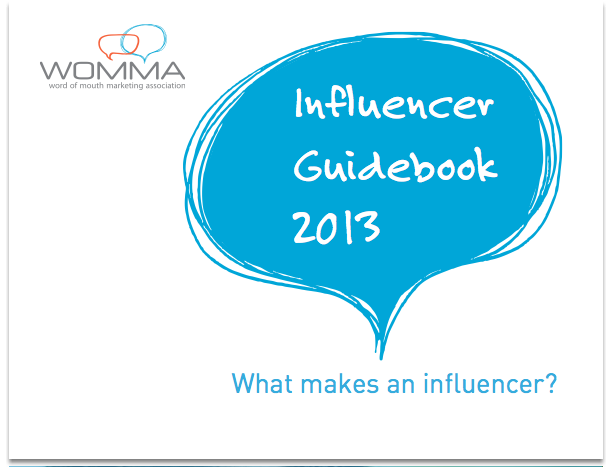
WOMMA Influencer Guidebook 2013

WOMMA's new guidance on influencer marketing begins with the assertion: "This is not an update to the 2008 WOMMA Influencer Handbook - this is a complete rewrite ..."

I'm not a WOMMA member but I am a special adviser to AMEC and The Conclave, and it was in this capacity that Brad Fay and I invested more than a few hours with WOMMA's Neil Beam to lend our insight and points of view and, we hope, help make this guidebook the complete rewrite it's turned out to be.

I've expressed Euler Partners' approach to influence in recent posts, notably "Influence - request for comments" (slidestack included below for your convenience), and we were delighted to have the opportunity to present these to the WOMMA team. In particular: Read more

Attenzi – a social business story

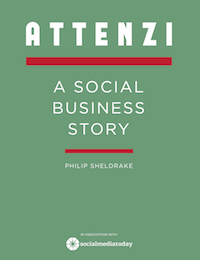
Attenzi bookccover

My new ebook is out today.

I'm really excited about it because I'm excited about its topic, social business. With a foreword by Adam Pisoni, Microsoft Yammer co-founder and CTO, here's how the book is presented.

Attenzi – a social business story shines a light on social business that goes beyond the all too typical homages to social media. It’s a relatively short and easy read intended to help readers explore what social business means for their organization, marketplace, communities and career.

The story is designed to galvanize the organization.

As the tale unfolds, you’ll consider aspects of organizational design, business performance management, marketing, public relations, branding, complexity, and the imminent empowerment of the individuals that make up any and all organizations. In fact, although you’ll likely be reading the book in a professional capacity, you’ll be noting the implications for your other roles in life too.

Perhaps most controversially, the story begins to explore the evolution of the customer-centric mindset that has dominated management thinking for the past two decades.

I could write more here, but I've been doing a lot of that lately, so perhaps I should just invite you to click over to the ebook now.


What is social business?

[Originally written for the CIPR Friday Roundup.]

I've been writing Friday Roundups for five and a half years and this is my last one. The circulation has grown from eleven to nearly eleven thousand, we merged it into the CIPR three years ago, and I'm delighted it's carrying on in their safe hands.

We have covered the full gamut of PR topics in this time, but a tag cloud of the 275 roundups would probably need to render "social media" in font size 100!

Increasingly however accomplished social media practitioners are asking a most pertinent question – now what? Well, it appears the answer to that is acquiring the name "social business", and it's increasingly been my focus of recent times. You might say social media are the eggs in the social business cake.

I've tried to design one question to both convey what social business might be exactly and to give the person attempting an answer real pause for thought in relation to their own organisation. I think I'm making progress with the following question, what do you think?... Read more