Category: Technology (page 7 of 10)

Meanwhile in Mumbai

The Meanwhile team decamped to Mombai (aka Bombay) this week to find out what’s happening in the ‘I’ in BRIC – one of the fastest growing markets in the world. With a population of 20 million in a country of 1.2 billion and 771 million mobile phone subscriptions, no visitor to Mumbai is left in doubt that there’s an energy and urgency about the place, even if the traffic ends up being very far from fast as a result. (Seriously, the 3km between hotel and airport mid-morning took 30 minutes.)

The Indian economy

The OECD’s June 2011 review of India identifies adult literacy of 74% and a GDP per head US$1068 (equivalent to US$3296 of purchasing power parity). The review starts with this assessment: Read more

How data is transforming digital marketing

Digital marketing has come a long way in the past decade, as we’ve moved beyond putting existing materials online and learned how to really harness the native advantages of digital technologies.

The pace of change continues unabated, and among its most important drivers is data – and the meaning of that data.

Every one of us is going to be producing more data describing our use of digital products and services. This is what I like to call digital detritus. Detritus – discarded organic matter which is decomposed by microorganisms and reappropriated by animal and plant life – is interestingly analogous to our regard for, and treatment of, the data that we’re all shedding.

Big data

When it comes to the increase in data, we’re working on a logarithmic scale: we’re talking about hundreds and thousands of times more. Data in such quantities may well prove to have important new mathematical properties that are attractive to marketers, customer service and product development teams. Moreover, we don’t actually do much with the digital detritus today – it mostly resides in inaccessible log files, although the technology for collating it is becoming increasingly achievable and affordable.

What does this mean in everyday terms? Read more

Profiting from the New Web – the video

I posted about the Profiting from the New Web conference last month, and now the video summary of the day has been published. It was a real pleasure to chair the event and have the opportunity to provide some commentary in the video too.

Thanks to everyone who took the time to get in touch after the conference. I'm sure, given the overwhelming positive sentiment, that we'll be making this conference into a series. Watch this space.

The Web this decade and what it means for your organisation

I'm a fortunate geek. I got to chair the 6UK launch back in November, with keynote by Vint Cerf – fondly referred to as one of the fathers of the Internet. And on Monday this week, I chaired Profiting From The New Web at the Royal Society with keynote by Sir Tim Berners-Lee – inventor of the World Wide Web. How cool is that?!

Sir Tim Berners-Lee, New Web, London, 23rd May 2011

Sir Tim Berners-Lee, New Web, London, 23rd May 2011 (courtesy Intellect)

I worked with the Web Science Trust and Intellect to design this week's conference, and we set ourselves this mission:

Discover new and better ways to do business, run our countries, and lead fulfilling and sustainable lives via the intelligent, innovative and diligent development of the New Web, and to make progress faster than otherwise.

Web Innovation

The term Web 1.0 is applied retrospectively to a Web of documents and ecommerce. The term Web 2.0 has come to describe social community and user-generated content. The New Web – the Web of Data or the Semantic Web, and sometimes Web 3.0 – entails the Web itself understanding the meaning of that participation and content.

A component of the Web of Data, known as Open Data, encompasses the idea of freeing data so that others may query it, check and challenge it, augment it, and mash it up with other sources. Sir Tim is particularly motivated by this vision given its potential to drive scientific breakthrough, enhance delivery of public services and open up new frontiers for competitive advantage. Read more

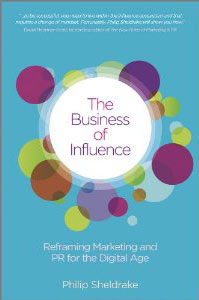
My book, The Business of Influence, is out today

Today's the day!

It's ready for delivery in the UK today, and pre-order in other parts of the world. For those of you tweeting about availability in the US, currently listed as mid-June by some bookstores, Wiley tells me it should actually be with you mid-May. Thank you for your interest and patience.

What's it about?

The Business of Influence: Reframing Marketing and PR for the Digital AgeThe Business of Influence is a rethink.

It's about improving the capabilities of organisations to design and attend to the way in which all aspects of its operations influence stakeholders, about making sure stakeholders influence it, systematically, and about how well competitors are attempting the same. It focuses on influence as the common denominator of marketing and public relations and related activities such as customer service, sales, product development and HR, and therefore the basis for redesigning these and interconnecting them.

The book introduces the Influence Scorecard, named in homage to the dominant framework for business performance management, the Balanced Scorecard. The Influence Scorecard then is a subset or view of the Balanced Scorecard containing all the influence-related key performance indicators (KPIs) stripped of functional silo, and it may extend beyond the Balanced Scorecard should a greater operational granularity of metrics be demanded by the influence strategy.

The Influence Scorecard is a new framework for the 21st-century designed to help organisations focus on what matters rather than continue to carry the baggage and inefficiencies that come part and parcel of the typical 20th-century marketing and PR structure and approach. It's a reframing in the context of 21st-century media and disintermediation, 21st-century technology, and 21st-century articulation of and appreciation for business strategy. Read more

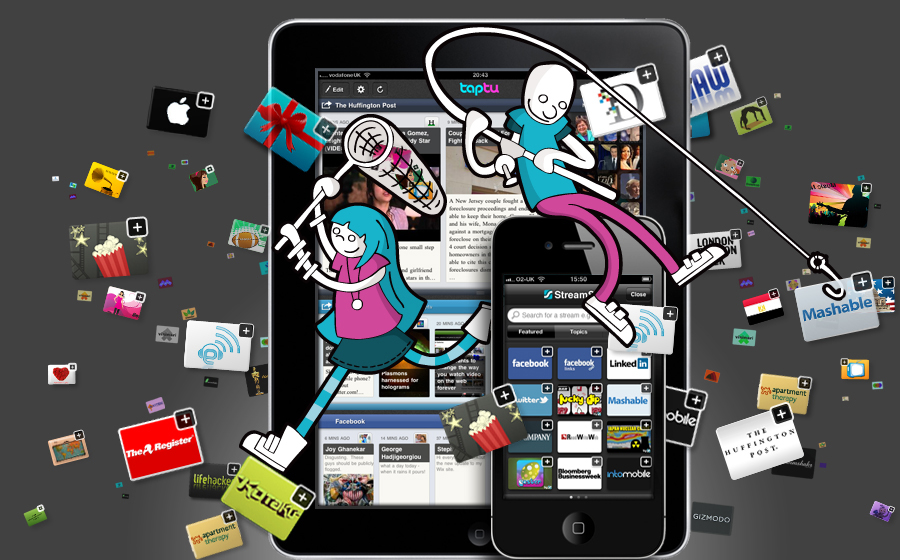
Taptu for iPad – with gorgeous illustration

Taptu Web Fishing illustration

With a spike in visitors to my blog exceeding 1000% of normal activity, the most popular post of all time on this blog is Content – an illustrated history. That obviously excludes the much greater exposure the illustration by Nic Hinton (@karoshikula) and me will have garnered when Mashable and Wired ran with it, and I've since heard that the illustration is being used to teach university students and school kids, and for the purposes of social media training in organisations.

I mentioned in the updates to that post inserted during the ensuing days that Taptu CEO Mitch Lazar had become smitten with the illustration style and had expressed an interest in applying the style at Taptu in future. Well now they've done just that.

Today, the next generation of the popular and free social news reader comes out for iPhone and iPad (it's already rocking and rolling on Android). Taptu calls it the social news DJ – allowing you to mix your favourite news streams. I've posted some of the illustrations used in the app here, but there's nothing quite like checking the app out for yourself and seeing all of them in all their glory... particularly on the larger screen of the iPad. I've also posted a video of the new iPad version in action.

I consider an app like Taptu to be an indispensable tool in the PR professional's armoury. Do you have a favourite social news reader?

Read more

Influence in the age of the social web – keynote to EUPRERA

It's a beautiful sunny Spring day here at the EUPRERA Spring Symposium in Lisbon. It's my first time at this gathering of the European Public Relations Education and Research Association – the forum for innovative PR research and education – and I'm delighted to have been invited to deliver the keynote.

Thanks to Philip Young and David Phillips for the invitation. Here's the slidestack. I was a bit surprised to get a slide count of 77, but 16 of the slides present the infographic 'Content – An illustrated history', which is easy to breeze through :-)

The Marketing Century – a compilation of expert insight

The Marketing CenturyYou can now get your hands on The Marketing Century – out this week – a compilation of expert insight across a wide gamut of marketing and PR related topics to celebrate the centenary of the Chartered Institute of Marketing (CIM). The chapter outline here is based on the book's introduction.

I'm delighted to have authored the chapter on digital marketing, and I'm more than happy to answer any questions you may have on reading it.

Buy at Amazon / CIM / The Book Depository / Blackwell's / Waterstone's. And more info at Google Books.

1. Strategic Marketing (Martha Rogers and Don Peppers, Peppers & Rogers Group)

The Marketing Century opens with a clear statement from Don Peppers and Martha Rogers: it is vital that organisations put customers at the heart of what they do, both in the long-term and the short-term. To create value, firms must lift their sights from the typical focus on current profits and instead start seeing customers as the company's long-term resource – looking at each customer in terms of the long-term return they generate. A long-term strategy for marketing – one that focuses on customer equity and not solely on current profits – can provide marketing with the context and objectives needed to maximise the overall value created by each customer. Read more

Content – an illustrated history

UPDATE 1: Thank you to Wired, Mashable, @dmscott, @guykawaski and everyone else who has posted and shared our illustration :-)

UPDATE 2: Now available in Slideshare format.

UPDATE 3: Now available in for printing or anything else you fancy.

UPDATE 4: Now available in Spanish. Thanks to @FollowFlock & @rulsCC.

UPDATE 5: Taptu CEO Mitch Lazar loves our style (and the Taptu reference no doubt!) so we agreed earlier this week to apply our illustrative style to Taptu's brand communications going forward. Cool.

UPDATE 6: The Slideshare format made the number 1 slot on Slideshare's homepage for part of the day on the 27th Jan, and accrued over 4,000 views in 48 hours.

UPDATE 7: August 2011. Now available as a YouTube video. Don't know why we didn't think of it earlier! Embedded below.


No-one with a smattering of social Web literacy can fail to marvel at what's taken place in recent history. The rate of change has been unprecedented.

Who would have thought thirty years ago that the Internet would go mainstream and the World Wide Web would transform content business models (and many other business models come to that) so radically?

Who would have thought twenty years ago that the average Joe would carry handheld devices as powerful as the Apple and Android devices?

Who would have thought ten years ago that consumers of media content could also, just as easily, be producers of media content?

Who would have thought five years ago that each and everyone of us could, with a stroke of a touch screen, design their own content channel and publish it. Read more

A non-techie explanation of how web pages are secured

I first published this overview back in 2004. I'm prompted to update and repost it here because the original website is no longer live (it was the website for Fuse PR back in the day), because I was talking about it with some Meanwhile colleagues this week, and because it's interesting. No seriously, it is.

When is a web page secure?

Content on a web page is secured when the URL starts "https://" rather than "http://". Saying that, this doesn't mean that all content on a page marked as such is secured, but if you're on a website of a trusted source, like Amazon, you may be happy to assume that the parts that need to be are, by design.

https

If you'd like to find out what other information your browser gives you about the level of security for a particular web page, check out the relevant link here: Read more